Can Your Employer Take Your Tips? Tip Pool Rules for Servers (2026)
Published
Quick answer: No. Under federal law your employer, and any manager, supervisor or owner, can't keep any part of your tips, whether you're paid $2.13 an hour or the full minimum wage. What your employer can do is require a tip pool or tip-out: shared only with others who usually get tips (servers, bartenders, bussers) if it pays you less than minimum wage before tips, or with cooks and dishwashers too if it pays the full minimum wage. It can take the card company's actual fee off a card tip, and nothing more. A service charge isn't a tip at all. Your state's law can be stricter.
A tip is a gift from the guest to the people who served them. Since 2018 federal law has said so in plain terms: an employer may not keep its workers' tips “for any purposes,” and neither may its managers and supervisors. That one rule settles most arguments about tips. The rest is detail: who can share a tip pool, what can come off a card tip, and why a service charge isn't a tip at all.
Here's what the law allows, what it doesn't, and what you can do if your tips are disappearing. Everything below is federal law, the floor for every state. Where your state's law gives you more, your employer has to follow that instead.
The rule: your employer can't keep your tips
The Fair Labor Standards Act (FLSA) bans employers from keeping any part of their employees' tips, directly or through a tip pool. It doesn't matter how you're paid. Whether you get $2.13 an hour plus tips or $20 an hour plus tips, your employer can't require you to hand any of them to the business, a manager or a supervisor.
Owners who hold at least a 20% stake and help run the place count as managers here. So the owner who works the floor on Fridays can't dip into the servers' tips either.
Who counts as a manager
Not the title on the schedule. The Department of Labor looks at what the person actually does. A manager or supervisor, for tips, is someone who:
- mainly manages the restaurant or a department of it,
- regularly directs the work of at least two full-time employees (or the equivalent), and
- can hire or fire, or whose recommendations on hiring and firing carry real weight.
In September 2026 the Department answered a question servers ask all the time, in opinion letter FLSA2026-13. A “shift supervisor” who also worked bartending shifts was collecting a tip-out from the servers. If that supervisor's duties match the test above, the answer is no: they can't take any part of other employees' tips, even on nights they're behind the bar. They can keep tips their own bar customers leave them. But if the bartenders' tips are pooled and split for the shift, the supervisor can't take a share of that pool.
Two more things the rules allow: a manager who serves their own tables keeps those tips, and an employer can require a manager to pay into the tip pool. A manager can never take money out of it.
Tip pools and tip-outs: legal, with limits
Your employer can require you to share tips, whether it calls that a tip pool, tip sharing or a tip-out. The law treats them all the same way. Who can be in the pool depends on one thing: what your employer pays you before tips.
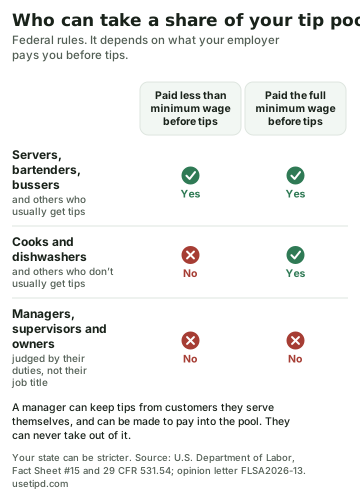
- If you're paid less than the minimum wage before tips (the “tip credit,” like $2.13 an hour), the pool can only include people who customarily and regularly get tips: servers, bartenders, bussers and the like. Your employer has to tell you how much you're required to contribute.
- If you're paid at least the full federal minimum wage before tips, the pool can also include cooks, dishwashers and other back-of-house staff.
- In both cases, managers, supervisors, owners and the business itself get nothing from the pool.
Two things surprise people. First, federal law sets no maximum percentage for a valid tip pool, so a required 20% or 30% tip-out isn't illegal on its own (some states are stricter). Second, when your employer collects tips to run the pool, it has to pay them all out by your regular payday for that week.
Credit card fees: only the real cost
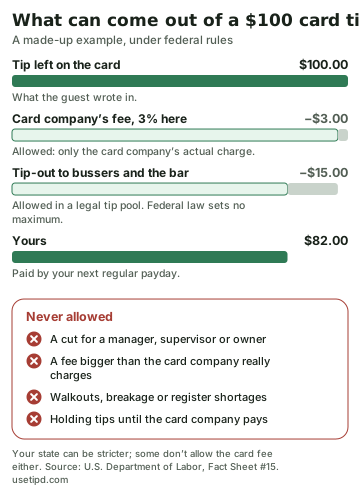
When a guest tips on a card, your employer can take out the percentage the card company actually charges it, and only that. The Department of Labor's own example: if the card company charges 3%, you get 97% of the tip. A flat “processing fee,” an “admin fee,” or anything above the real charge is the employer keeping your tips.
The fee also can't push your pay below the minimum wage, and your card tips have to be paid by your regular payday. Your employer can't hold them while it waits for the card company to pay. Some states don't let employers take the card fee out of tips at all.
A service charge isn't a tip
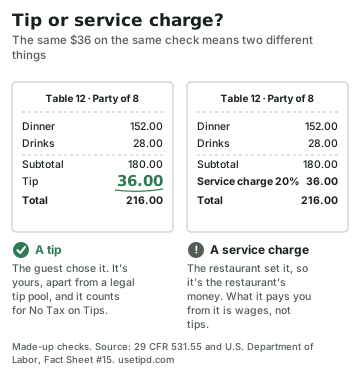
The 20% the restaurant adds to a party of eight is a service charge, not a tip, because the guest didn't choose it. Legally it's the restaurant's money. If the restaurant passes some or all of it to you, that's wages: it can count toward your minimum wage, and it goes into your regular rate for overtime. It also doesn't count for the No Tax on Tips deduction, which only covers tips.
Anything a guest adds on top of a service charge is a tip, and everything above applies to it.
Other ways tips go missing
- Walkouts, breakage and register shortages. If you're paid less than minimum wage before tips, your employer can't deduct these from your pay, because it would put you below minimum wage. Taking them out of your tips is the employer keeping your tips.
- Tips that don't reach minimum wage. At $2.13 an hour, your pay plus your tips has to reach at least $7.25 for every hour in each workweek (more where your state's minimum is higher). If it doesn't, your employer has to make up the difference on that payday.
- No notice. Before paying you less than minimum wage before tips, your employer has to tell you your cash wage, the tip credit it's claiming, and that you keep all your tips except for a legal tip pool. Without that notice, it owes you the full minimum wage.
- Side work. You may have heard of the “80/20 rule” for side work. It's gone: a federal appeals court struck it down in 2024, and the Department of Labor went back to its older rule. Duties that go with serving, like rolling silverware or setting tables, are part of the tipped job. A truly separate job, like doing the restaurant's maintenance, can't be paid at the tipped rate.
What to do if your tips are being taken
- Write it down. Dates, shifts, what you made in cash and on cards, what you tipped out and to whom, and what showed up on your paycheck. A record made at the time is worth far more than a memory.
- Check your pay stubs. Card tips, the tip credit and any service charges should be there.
- Ask, in writing if you can. Plenty of problems are payroll mistakes, and a text or email leaves a record.
- File a complaint with the Department of Labor's Wage and Hour Division at 1-866-487-9243, or with your state's labor office. Complaints are confidential, and your employer can't legally punish you for making one.
An employer that keeps tips owes back the tips, plus any tip credit it took, plus an equal amount again as damages. You generally have two years to claim, or three if the violation was willful, so don't wait too long.
The record in step one is the hard part, and it's the part Tip’d is built for. It's a tip tracker for iPhone: log each shift's hours, cash tips, card tips and what you tipped out in a few taps, keep two jobs separate, and see what you really made an hour. If a paycheck ever looks short, you'll have the numbers, shift by shift. Logging shifts is free, and your shifts stay in your own iCloud.
Questions people ask
Can my manager take tips from the tip pool?
No. Managers and supervisors can't take anything from a tip pool or tip-out, even on shifts when they serve or bartend. They can keep tips from customers they personally serve, and they can be required to pay into the pool.
Can the owner keep the tips?
No. The business, and any owner with at least a 20% stake who helps run it, can't keep any part of employees' tips.
Can my employer make me share tips with the kitchen?
Only if it pays you at least the full federal minimum wage before tips. If you're paid less, like $2.13 an hour, the pool can only include people who usually get tips.
Is it legal to make me tip out 30%?
Under federal law, yes, as long as the pool is legal: no managers or owners in it, and no kitchen staff if you're paid less than minimum wage before tips. Federal law sets no maximum. Your state may.
Can my employer take the credit card fee out of my tips?
Only the percentage the card company actually charges, and only if your pay stays at or above minimum wage. Some states don't allow it at all.
Is an automatic gratuity my tip?
No. A gratuity the restaurant adds automatically is a service charge. It belongs to the restaurant, and whatever it pays you from it is wages.
Can my employer hold my tips?
Not past your regular payday. Card tips and tips from a pool have to be paid by the regular payday for that workweek.
What happened to the 80/20 rule?
A federal appeals court threw it out in 2024, and the Department of Labor restored its older rule that December. Side work that goes with your tipped job is part of it; a separate job isn't.
Can I be fired for complaining about my tips?
Retaliating against a worker for complaining about wage and tip violations, or for helping an investigation, is illegal under federal law.
Sources
- U.S. Department of Labor: Fact Sheet #15, Tipped Employees Under the FLSA
- U.S. Department of Labor: Tip Regulations under the FLSA (including the 2024 ruling on dual jobs)
- U.S. Department of Labor: Opinion letter FLSA2026-13 (September 7, 2026) (supervisors and tip-outs)
- 29 CFR 531.52: General restrictions on an employer's use of its employees' tips
- 29 CFR 531.54: Tip pooling
- 29 CFR 531.55: Amounts not received as tips (service charges)
- 29 U.S.C. 216: Penalties and 29 U.S.C. 255: Statute of limitations
- U.S. Department of Labor: How to file a complaint
- U.S. Department of Labor: State labor offices