How to Carry Plates and Trays Like a Pro Server (With Videos)
Published
Quick answer: Hold the first plate with your thumb and pinky over the rim and three fingers underneath, so your palm takes the weight; rest the second on your thumb, pinky and forearm; carry the third in your other hand. Load a tray heaviest in the middle, over your hand, and unload it from the outside in, taking from opposite sides in turn.
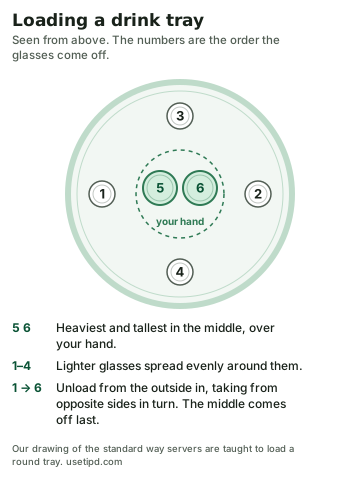
Carrying plates is the first thing a new server gets judged on and the last thing anyone teaches properly. Get it right and a four-top's food arrives in one trip, hot, with a hand free. Get it wrong and you make three trips, your wrist aches by Friday, and sooner or later a plate ends up on the floor. Below are the four carries every server uses: three plates, a drink tray, a big tray on your shoulder, and clearing a table. Each has a short training video you can play right here, the steps written out under it, and there's a picture of how to load a drink tray.
One note before you start: every restaurant has a house way. Some fine-dining rooms want plates carried one in each hand or brought out on a tray, and some kitchens hand plates off in a set order. When your trainer shows you something different, do it their way.
Carry three plates
The three-plate carry is two plates in one hand and arm and a third in the other hand. The grip below is the one in the video. It puts the weight on your palm instead of your wrist.
- First plate, in the hand you don't write with. Spread your thumb and pinky wide and hook them over the rim, on top. Spread your middle three fingers underneath. Your palm and those three fingers take the weight. Don't pinch the rim between your thumb and fingers: your wrist ends up holding the whole plate, it gets heavy fast, and your thumb sits in the food where the guest can see it.
- Second plate, on your thumb, pinky and forearm. Rest it on the thumb and pinky that are hooked over the first plate, with its far side on your forearm. Your pinky keeps the bottom of the second plate up off the first one, so it isn't sitting on someone's food and it can't slide.
- Third plate, in your free hand, held the way you held the first.
- Read the ticket before you leave the window. Learn which seat gets which plate first, then look at the table number. The video's trick: look at the table number first and you'll forget it while you memorize the seats.
Restaurant plates are heavier than the ones at home, and hot. Practice with empty plates before a shift, keep a folded side towel for plates straight out of the oven, and carry fewer when a plate is full of soup or sauce. Two careful trips beat one plate in a lap.
Carry a drink tray
A round cocktail tray is for drinks, and it's how you get six drinks to a table without two trips to the bar.
- Hold it on your fingertips and the heel of your hand, not your flat palm, with your fingers spread under the middle of the tray. Bend your elbow so the tray sits around waist height, close to your body.
- Load it from the middle out. The heaviest and tallest drinks go in the center, over your hand. Lighter glasses go around them, evenly spaced, so no side is heavier than another.
- Look where you're going, not at the glasses. Walk at a normal pace and let the tray ride. Staring at the drinks makes you slow down and correct, and the correcting is what spills them.
- Unload from the outside in, taking from opposite sides in turn, so the tray stays level. The middle comes off last. Serve with your other hand and hold the tray away from the guest, behind the chairs rather than over the table.
Carry a big tray on your shoulder
For a party too big to carry by hand, the food comes out on a large oval tray at your shoulder, with a folding tray stand (a tray jack) at the table to set it on.
- Get the tray stand ready first. Open it beside the table, out of the walkway, or carry it folded in your free hand and open it when you get there.
- Load the tray level, heaviest in the middle, where your hand will be, with the weight even from end to end.
- Lift with your legs. Slide the tray to the edge of the counter, bend your knees, get your palm under the middle, and stand up with it, bringing it up to your shoulder. Don't reach out and lift it with your back.
- Hold it with more than one point of contact: your palm under the center and the tray resting near your shoulder, with your other hand on the front edge whenever you need to steady it.
- If it starts to tip, stop. Set it down on the nearest stand or table right away instead of trying to save it while you walk. A tray that's leaning only gets worse with each step.
- Serve from the stand, never from your shoulder. Set the tray on the stand, then take the plates to each guest.
Clear a table in one trip
Clearing (pre-bussing, while the guests are still at the table) uses the same grip as carrying, with one plate for scraps and another for stacking.
- Start with the messiest plate, the one with chicken bones or half a burger that nothing could stack on. Hold it the way you carried it out: thumb and pinky over the rim, three fingers under, weight on your palm.
- Take a cleaner plate next to stack on.
- For each plate after that, move its silverware and ramekins onto the first plate, then stack it on the second.
- Slide the knife blade through the fork's tines so the silverware can't slide off.
- Don't touch the food. If there's a mess on the table, wipe it onto your plate with a napkin.
Ask before you take a plate, and in most dining rooms wait until everyone at the table has finished unless a guest hands you theirs. The video also makes an honest point: it was the fourth take and the server's arm was done. It's a physical job, which brings us to the next part.
Save your back, wrists and feet
- Lift from your legs and keep loads close. Reaching out with a full tray puts its weight on your lower back.
- Let your palm carry the plate. The grip above exists to spare your wrist and fingertips; pinching is how wrists start to hurt.
- Carry from your core, and stretch after the shift. WaiterWise's video on carrying heavy plates without straining your muscles covers posture and the stretches to do after work.
- Wear the right shoes. Technique doesn't help much on a sore foot or a slick floor. Our guide to the best shoes for servers ranks the slip-rated pairs servers keep buying.
Fewer trips, more tables
Carrying well is mostly about time. Every trip you save goes back to your tables: a refill before anyone asks, the check dropped the moment they're ready, one more turn of your section on a busy night. That's where tips come from.
If you want to see whether it shows up in your pay, write your shifts down. Tip’d keeps each shift's tips, tip-outs and hours on your iPhone, works out what you really made an hour, and its Trends show what you average by position, shift type and day of the week. Logging shifts is free, with no ads and no account. To see how your hourly compares, our guide to server pay by state has every state's numbers.
Videos in this guide
- Real Server Training, “How to carry plates - restaurant server training” (October 25, 2020)
- Waiter, There's more!, “How to Carry Trays Like a Pro (Beginner Techniques)” (May 5, 2025)
- Real Server Training, “Using Trays | Restaurant Server Tips” (January 8, 2026)
- Real Server Training, “How to pre-bus plates: An effective, efficient system for restaurant servers” (November 16, 2020)
- WaiterWise, “How To Carry Heavy Plates And Avoid Strained Muscles In A Restaurant” (September 12, 2019)
The videos belong to their channels; we picked them, and Tip’d isn't paid for them. They play from YouTube's privacy-enhanced mode only when you press play (see our privacy policy).