How to Make More Tips as a Server: What the Research Says
Published
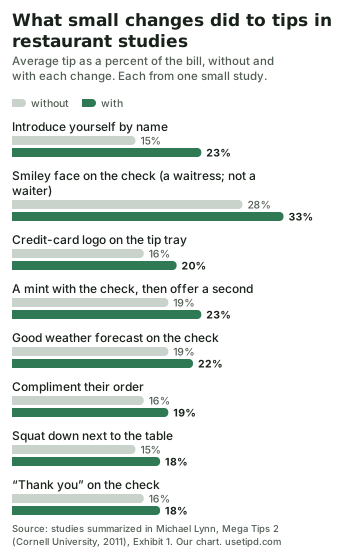
Quick answer: In restaurant studies, servers got bigger tips by introducing themselves by name (15% to 23% of the bill), squatting next to the table (15% to 18%), writing “thank you” on the check (16% to 18%), complimenting what guests ordered (16% to 19%) and offering a second mint with the check (19% to 23%). Each result comes from a small study, so try one change at a time and track your tips for a few weeks to see what works for you.
Most advice about tips is somebody's opinion. This isn't. For more than thirty years, Michael Lynn, a professor at Cornell's hotel school, has studied what makes restaurant guests tip more, and in 2011 he gathered the experiments into a short guide for servers, Mega Tips 2. In those studies, a server tried something on some tables and not on others, picked at random, and compared the tips.
Two things to know before the list. First, the biggest driver of a tip is the size of the bill: most people tip a percentage. Second, the quality of the service matters less than you'd hope. Across 24 tests in 21 restaurants, the link between how guests rated the service and what they tipped was weak, and going from average to excellent service raised the typical tip by less than 3% of the bill. So the small things below, the ones that make guests feel looked after, are where a server has the most room to move.
What the studies found
At the table
- Introduce yourself by name. A waitress at a Sunday brunch who greeted tables with “Good morning. My name is Kim…” got 23% of the bill, against 15% when she left her name out. Keep it natural; Lynn warns that a stiff script can backfire.
- Squat down next to the table. Getting to eye level on the first visit raised one waiter's tips from 15% to 18% and one waitress's from 12% to 15%. It suits casual places better than fine dining.
- Smile like you mean it. In a 1977 study, a cocktail waitress got more than twice as much in tips from customers she gave a broad smile as from those who got a small one.
- Repeat the order back. In two Dutch studies, a waitress who repeated each order word for word, instead of saying “okay” or “coming up,” got tips 69% and 100% bigger.
- Compliment what they ordered. Telling guests they'd picked well raised tips from 16% to 19% in one study, though it helped less with big parties.
On the check
- Write “thank you.” It took one waitress from 16% to 18%. Adding her name didn't help further.
- Draw a smiley face, if you're a waitress. It raised a waitress's tips from 28% to 33%, but a waiter's didn't rise at all.
- Offer a second mint. One piece of candy with the check barely mattered (19.0% to 19.6%), two pieces helped (21.6%), and one piece followed by coming back to offer another did best (23.0%). Ask your manager first.
- Share a good forecast, when it's true. A note on the check that tomorrow's weather looked great raised tips from 19% to 22%.
- Use a tray with a card logo. Check presenters showing a credit-card logo raised tips from 16% to 20% in a 1996 study. That one's your manager's call.
Sell a little more
Because most guests tip a percentage, a bigger check means a bigger tip. In an older study, a waitress who suggested a second drink, an appetizer and dessert raised her average check by about a quarter. On a slow night that's free money. On a packed night it can cost you a table turn, so read the room.
What we'd skip
Studies also found that a light touch on the shoulder raised tips. We'd leave that one out: plenty of guests don't want to be touched, and it isn't worth the risk to you. The same goes for anything that feels like a trick. Every item above works because it makes guests feel noticed, and that only works when it's real.
Why tracking your tips matters
Here's the catch with every result above: they're averages from someone else's restaurant. Yours may differ, and tips swing so much from one table, shift and month to the next that a single great Friday proves nothing. Lynn's own advice is to test a technique on your own shifts before you trust it.
That's why tracking your tips matters, and not only for experiments. When you write down every shift's tips and hours, you can:
- See what actually works. Lynn suggests trying a change on half your shifts and not the other half, at least 10 shifts each (20 is better), then comparing. Note which shifts were which, and compare tips per hour on similar shifts.
- Know your real hourly pay. Your hourly wage plus tips, minus tip-outs, divided by hours, is the number that tells you whether a job, a section or a schedule is worth it.
- Pick your best shifts. After a few months, your own numbers show which days and positions pay best, which is worth knowing before you ask for a schedule change.
- Stay right with the IRS. Cash tips have to be reported to your employer every month, and a daily record is what backs you up. See how to report cash tips.
- Make sure you're paid the minimum. In tip-credit states, your wage plus tips has to reach the full minimum wage; a record is how you'd know if a slow week fell short. See the tipped minimum wage in 2027.
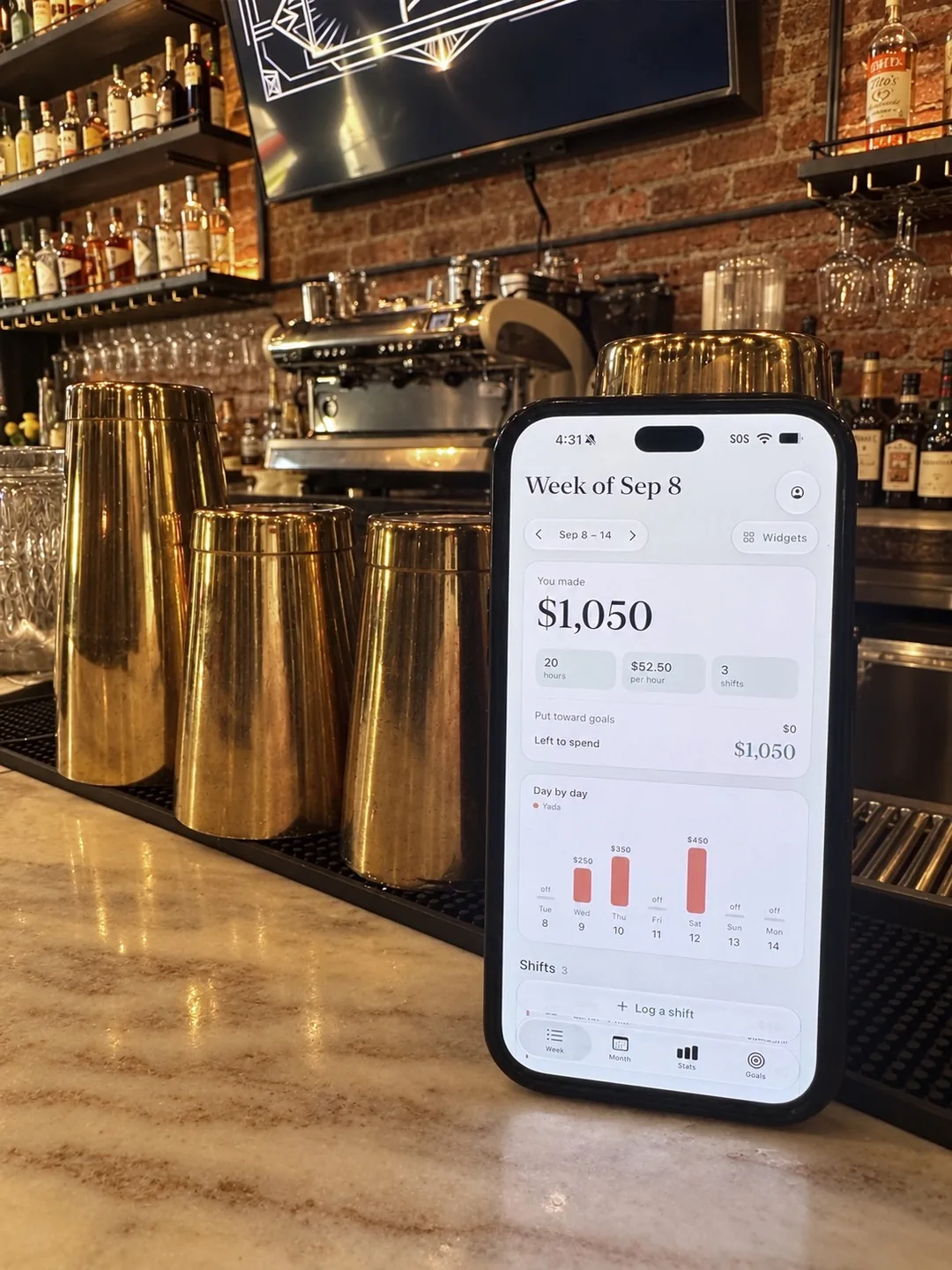
Tip’d does this on your iPhone. Log a shift in a few seconds (cash, card, tip-outs and hours, and a note like “tried the second mint”), and Tip’d shows what you really made an hour, your week day by day, and, in Trends, what you average by position, shift type and day of the week. Logging shifts is free, with no ads and no account.
A simple four-week test
- Pick one change from the list, the one that feels most like you.
- Do it on every table on alternating shifts, and not on the shifts in between.
- Log every shift, with a note saying whether you used the change.
- After four weeks, compare your average tips per hour on the two kinds of shifts, lunch against lunch and dinner against dinner.
- Keep what works, drop what doesn't, and try the next one.
Sources
- Michael Lynn, “Mega Tips 2: Twenty Tested Techniques to Increase Your Tips”, Cornell Hospitality Tools, 2011 (Exhibit 1 and the advice on testing), and “Mega Tips”, Cornell Center for Hospitality Research, 2004
- Michael Lynn, “Restaurant Tipping and Service Quality: A Tenuous Relationship”, Cornell Hotel and Restaurant Administration Quarterly, 2001
- Garrity & Degelman, “Effect of server introduction on restaurant tipping”, Journal of Applied Social Psychology, 1990
- Lynn & Mynier, “Effect of server posture on restaurant tipping”, Journal of Applied Social Psychology, 1993
- Tidd & Lockard, “Monetary significance of the affiliative smile”, Bulletin of the Psychonomic Society, 1978
- van Baaren, Holland, Steenaert & van Knippenberg, “Mimicry for money”, Journal of Experimental Social Psychology, 2003
- Seiter, “Ingratiation and gratuity”, Journal of Applied Social Psychology, 2007
- Rind & Bordia, “thank you” on the check (1995) and smiley faces (1996), Journal of Applied Social Psychology
- Strohmetz, Rind, Fisher & Lynn, “Sweetening the till: The use of candy to increase restaurant tipping”, Journal of Applied Social Psychology, 2002
- Rind & Strohmetz, “Effect of beliefs about future weather conditions on restaurant tipping”, Journal of Applied Social Psychology, 2001
- McCall & Belmont, “Credit card insignia and restaurant tipping”, Journal of Applied Psychology, 1996
- Butler & Snizek, “The waitress-diner relationship”, Sociology of Work and Occupations, 1976
- Crusco & Wetzel, “The Midas touch”, Personality and Social Psychology Bulletin, 1984