How to Report Cash Tips: The $20 Rule, the 10th of the Month, and What Happens If You Don't
Published
Quick answer: If your tips at one job add up to $20 or more in a month, cash and card together, report them to that employer by the 10th of the next month (the next business day if the 10th is a weekend or holiday). Report what you kept after tip-outs, plus tips other employees gave you. Use your employer's system, or a signed statement with your name, address, Social Security number, the month and the total. No IRS form is required: Forms 4070 and 4070A were retired in 2024. Keep a daily tip record. Tips you don't report still go on your tax return through Form 4137, and the IRS can add a penalty of half the Social Security and Medicare tax on them.
Once a month, the IRS asks everyone who works for tips to do one small chore: tell your employer what you made. At a lot of restaurants it's a box on the screen when you clock out. At others it's a slip of paper nobody explains. Either way, the rules behind it are short, and getting them right matters more than ever now that reported tips can be deducted under No Tax on Tips.
Here's the whole thing: who has to report, by when, what counts, how to keep the record, and what happens if you don't. It's federal tax law, so it's the same in every state.
The $20 rule: who has to report
If your tips at one job add up to $20 or more in a calendar month, you have to report them to that employer. Under $20 at a job, you don't report that month's tips to the employer, but they're still income and still go on your tax return.
Two things trip people up:
- “Cash tips” includes your card tips. To the IRS, a cash tip is any tip paid in money: bills, checks, credit and debit cards, gift cards and payment apps. Concert tickets or a bottle of wine from a regular are noncash tips, which you don't report to your employer but do put on your tax return.
- The $20 counts job by job. If you work at two places, each is its own count and gets its own report. $15 in a slow month at the Sunday brunch job doesn't have to be reported there, even if your other job brought in $1,800.
The deadline: the 10th of the next month
Each month's tips are due to your employer by the 10th of the following month: September's by October 10, October's by November 10, and so on. If the 10th falls on a Saturday, Sunday or legal holiday, you have until the next day that isn't one.
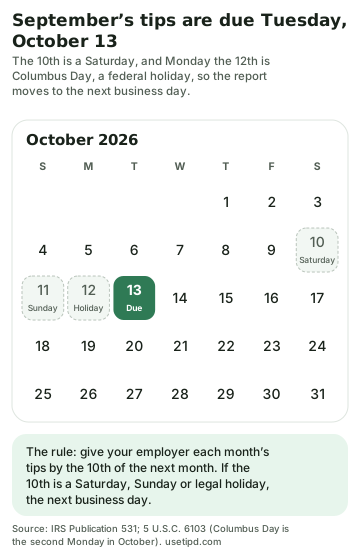
Your employer can ask for reports more often, and many do, every shift or every week. A single report just can't cover more than one calendar month. If you leave a job partway through a month, you can turn in that month's report when you go.
The next due dates, with the ones a weekend or holiday moved:
| Tips you got in | Report them by |
|---|---|
| September 2026 | Tue, Oct 13, 2026 (weekend, then Columbus Day) |
| October 2026 | Tue, Nov 10, 2026 |
| November 2026 | Thu, Dec 10, 2026 |
| December 2026 | Mon, Jan 11, 2027 (the 10th is a Sunday) |
| January 2027 | Wed, Feb 10, 2027 |
| February 2027 | Wed, Mar 10, 2027 |
| March 2027 | Mon, Apr 12, 2027 (the 10th is a Saturday) |
| April 2027 | Mon, May 10, 2027 |
| May 2027 | Thu, Jun 10, 2027 |
| June 2027 | Mon, Jul 12, 2027 (the 10th is a Saturday) |
| July 2027 | Tue, Aug 10, 2027 |
| August 2027 | Fri, Sep 10, 2027 |
| September 2027 | Tue, Oct 12, 2027 (Sunday, then Columbus Day) |
| October 2027 | Wed, Nov 10, 2027 |
| November 2027 | Fri, Dec 10, 2027 |
| December 2027 | Mon, Jan 10, 2028 |
One quirk: December's tips, reported in early January, count on the next year's W-2 and tax return. Tips you get in December 2026 and report by January 11, 2027 belong to your 2027 taxes.
What to report, and what to leave out
Report the tips you received and kept:
- cash tips from customers,
- card tips your employer pays you,
- tips other employees give you, like your share of a tip pool or a tip-out from the servers.
Leave out:
- What you tipped out. If you made $84 in cash and $212 on cards, then gave $40 to the bussers and the bar, you report $256 for that shift. The bussers report their $40.
- Noncash tips, like tickets or gifts. They go on your tax return, not to your employer.
- Service charges. An automatic 18% on a big party isn't a tip, and whatever the restaurant pays you from it is already wages. More on that in can your employer take your tips?
How to report: no IRS form needed
If your restaurant has its own way, use it. Usually the point-of-sale system asks you to declare your cash tips when you clock out, and it already has your card tips. The IRS lets employers take tip reports electronically, so that counts as your report.
If your employer has no system, give it a written statement with:
- your name, address and Social Security number,
- your employer's name and address, and the restaurant's name if it's different,
- the month (or the dates) it covers,
- your total tips for that period,
- your signature and the date.
Keep a copy. You may have heard of Form 4070 (the report) and Form 4070A (the daily record). The IRS retired both in 2024, along with Publication 1244, the booklet that held them, and says no particular form is required. If your employer still hands you an old 4070, it has everything a statement needs, so filling it in is fine.
Keep a daily tip record
The IRS also asks you to keep a daily tip record, so you can report accurately to your employer and on your tax return, and prove your tips if your return is ever questioned. You can write them in a tip diary, or keep copies of the things that show your tips, like receipts and card slips.
Start the record with your name, your employer's name and the restaurant's name. Then, each day you work, write down:
- the date,
- cash tips from customers and from other employees,
- card tips your employer pays you,
- the value of any noncash tips,
- what you tipped out, and to whom.
If your employer's system keeps your daily tips for you, the IRS says you have to get a paper copy of that record and keep it.
How to keep track with Tip’d
A tip diary only works if you fill it in every shift, so it has to be quick. That's what Tip’d is for. It's a tip tracker for iPhone, and logging a shift is one short form:
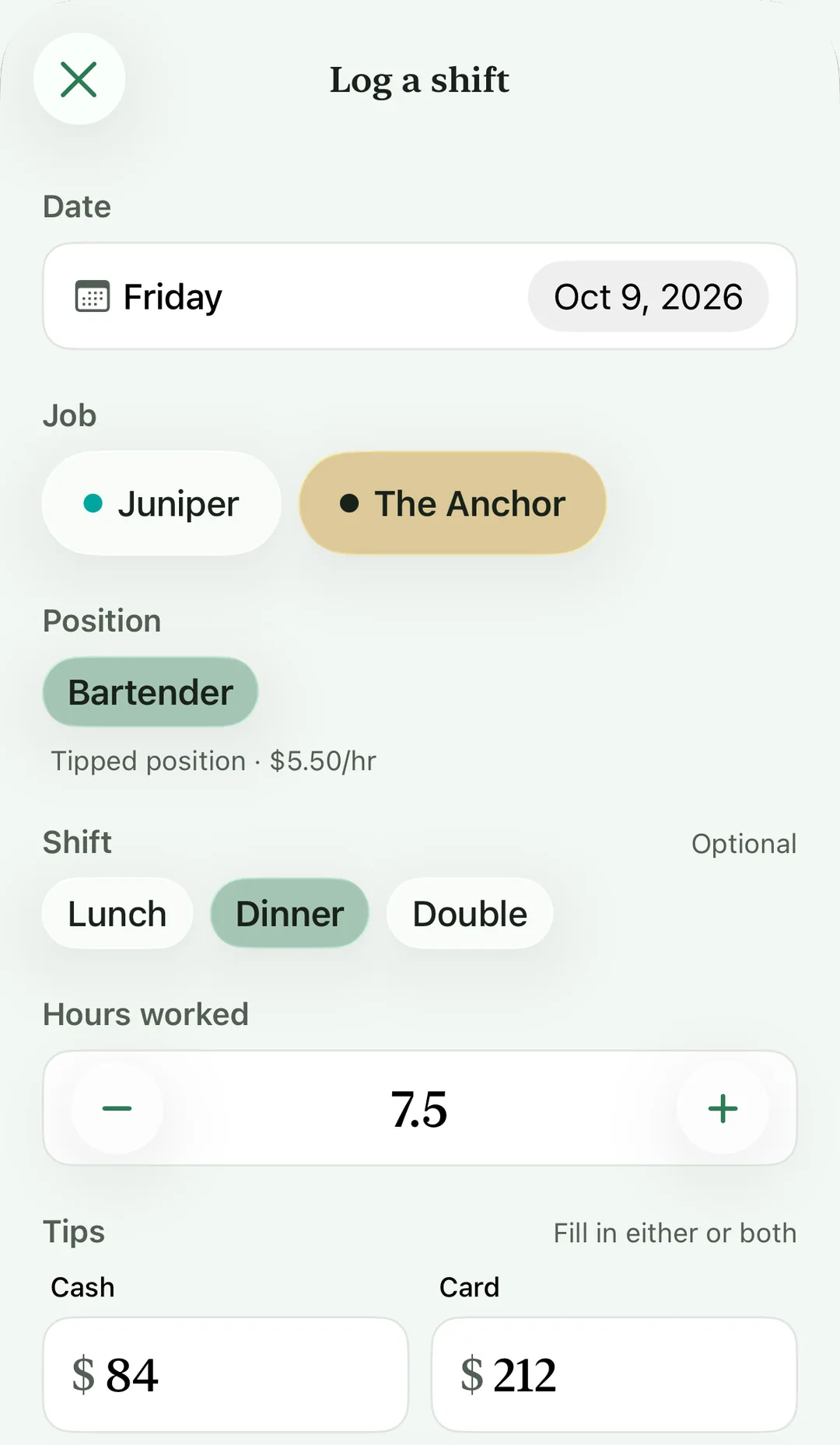
- Log the shift before you leave the parking lot. Pick the job, set your hours, and type your cash and card tips. Below them is Tipped out, and under Sales & notes there's room to write who you tipped out.
- Give each restaurant its own job. Tip’d keeps them apart, the same way the $20 rule and your W-2s do.
- Before the 10th, look over the month. The Month screen shows every day you logged, so a missing Saturday stands out before you report.
- Get your number. In Stats, open your year and export the spreadsheet. Its Shifts sheet lists every shift's date, job, cash tips, card tips, what you tipped out, and Tips kept, the amount you report. The Months sheet adds up tips kept for each month, for all your jobs together; with two jobs, filter the Shifts sheet by job.
- Check it against your employer. Compare your total with what the restaurant's system shows. If they don't match, ask now, not next February.
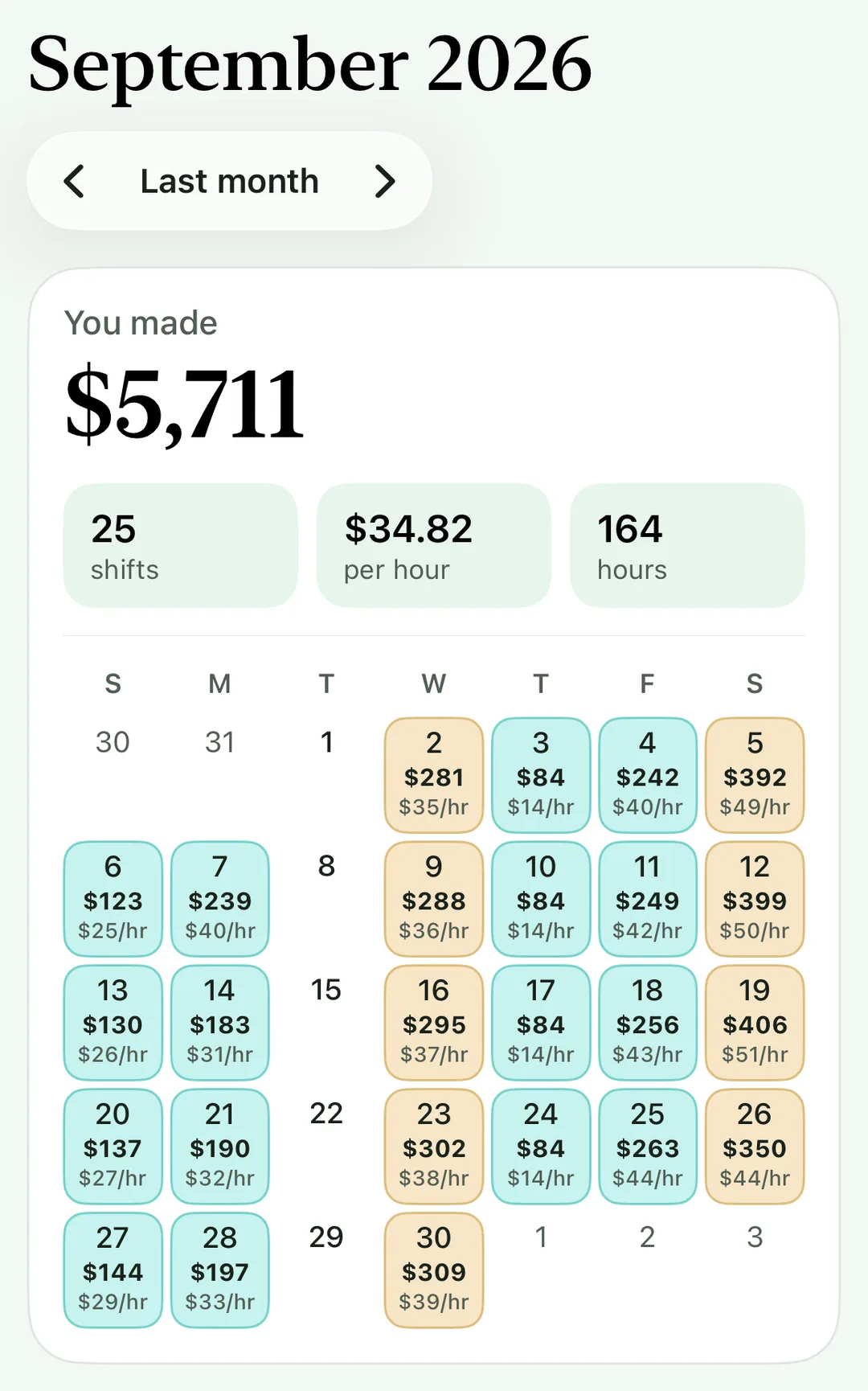
Logging shifts is free, and they stay in your own iCloud. At tax time, the year screen shows your cash tips for the year and how your tips compare with the $25,000 No Tax on Tips limit.
What happens if you don't report
Tips you don't report to your employer are still income. You have to put them on your tax return anyway, and pay the Social Security and Medicare tax on them yourself with Form 4137: 7.65% of the unreported tips (6.2% for Social Security and 1.45% for Medicare).
On top of that, the IRS can charge a penalty of 50% of that Social Security and Medicare tax. You can avoid it if you had a reasonable cause, explained in a statement attached to your return. For $1,000 of cash tips you never reported:
| On $1,000 of unreported tips | Amount |
|---|---|
| Social Security tax (6.2%) | $62.00 |
| Medicare tax (1.45%) | $14.50 |
| Possible penalty (50% of those) | $38.25 |
| Total, before income tax | $114.75 |
Income tax comes on top, the same as if you'd reported them. Two more ways unreported tips come back:
- Allocated tips. At a larger restaurant (more than 10 employees on a typical day, where tipping is customary), if the tips everyone reports add up to less than 8% of food and drink sales, the employer has to divide the difference among the tipped staff. Your share shows in box 8 of your W-2, with no tax taken out, and you generally have to report it through Form 4137, unless your records show you really made less. A daily tip record is how you show that.
- A smaller Social Security record. Reported tips count toward the earnings that set your Social Security retirement and disability benefits. Tips you never report don't.
Reporting and No Tax on Tips
Since 2025, tips can be deducted, up to $25,000 a year, but only tips that show up on a W-2 or 1099 or that you report yourself on Form 4137. On 2026 W-2s, the tips you reported to your employer appear in box 12 with code TP, the number you copy onto the deduction form. Tips you report late on Form 4137 can still count, but they can bring the 50% penalty with them. The Social Security and Medicare tax is owed either way, so reporting each month gets you the same deduction without the penalty.
Questions people ask
Do I have to report tips under $20?
Not to your employer, if all your tips at that job in that month come to less than $20. They still go on your tax return.
When do I have to report my tips?
By the 10th of the next month, or the next business day if the 10th is a weekend or legal holiday. September 2026's tips are due Tuesday, October 13, and October's by Tuesday, November 10.
Do I report card tips too?
Yes. To the IRS, card tips are cash tips. In practice your employer's system usually has them already, so what you declare at clock-out is mostly your cash.
Do I report the tips I tip out?
No. Report what you kept after tip-outs, plus any tips other employees give you.
Is Form 4070 still used?
The IRS made Forms 4070 and 4070A historical in 2024. Your employer's system, or any signed statement with your name, address, Social Security number, your employer's details, the period and the total, does the job.
What if I didn't report some tips?
Add them to the wages on your tax return and use Form 4137 to pay the Social Security and Medicare tax on them. The IRS may add a penalty of 50% of that tax unless you had a reasonable cause.
What if my paycheck is too small to take the taxes out?
You can give your employer money to cover them until the end of the year. Social Security and Medicare tax it couldn't collect shows in box 12 of your W-2 with codes A and B, and you pay it with your tax return.
What are allocated tips on my W-2?
An amount in box 8 that your employer assigned to you because the tips its staff reported came to less than 8% of sales. It isn't in box 1, no tax was taken out, and you generally report it on Form 4137 unless your daily record shows you received less.
Sources
- IRS Publication 531: Reporting Tip Income
- IRS: Tip recordkeeping and reporting
- IRS: About Form 4137, Social Security and Medicare Tax on Unreported Tip Income
- IRS: Instructions for Form 8027 (allocated tips and the 10-employee test)
- IRS Topic no. 751: Social Security and Medicare withholding rates
- 5 U.S.C. 6103: Holidays