Service Charge vs. Tip: Who Gets the Money, and Why It Matters
Published
Quick answer: A tip is money the guest chooses to leave, in an amount they decide. A service charge is a fee the restaurant adds, like an automatic 18% gratuity for a big party, and it's the restaurant's money. Under federal law the restaurant can keep all or part of it; whatever it pays you from it is wages, taxed like your hourly pay, and it doesn't count for the No Tax on Tips deduction. Some states, including Massachusetts, New York, Hawaii and Minnesota, make it go to the staff unless guests are clearly told otherwise, and others make restaurants say how it's split.
You've seen it on a party of ten: “Gratuity 18%, added for parties of 6 or more.” The guests think they've tipped. You think you've been tipped. The IRS says neither of you is right. That 18% is a service charge, and it's the restaurant's money until the restaurant decides otherwise.
It's worth knowing, because service charges are spreading well past big parties: a 20% charge on every check in place of tipping, a 3% “kitchen appreciation” fee, a surcharge for staff health insurance. Square found that in the second quarter of 2024, about 3.7% of restaurant payments on its system included a service fee, more than double the share at the start of 2022. Some restaurants pass every cent to the staff. Some keep part. Some keep all of it, and federal law lets them. Here's how to tell a tip from a service charge, where each one goes, and what it does to your taxes.
What makes a tip a tip
The IRS spelled out its test in a 2012 ruling, and it has four parts. A payment is a tip only if:
- The guest pays it freely. Nobody makes them.
- The guest decides how much, including nothing at all.
- It isn't negotiated or set by the restaurant's policy.
- The guest generally decides who gets it.
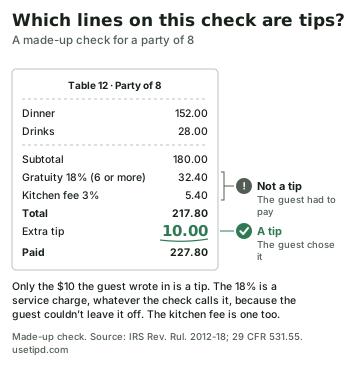
Miss any one and it's probably a service charge, whatever the check calls it. The IRS's own example is the big-party gratuity: an 18% charge a restaurant adds to every table of six or more isn't paid freely, so it's a service charge, not a tip. Anything the guest adds on top of it, on an extra tip line, is a tip.
When a charge on the check is still a tip
- Suggested tips. A check that prints what 15%, 18% and 20% would be, and leaves the tip line blank, is only making a suggestion. Whatever the guest writes in is a tip.
- A “recommended” gratuity the guest can change. If the check adds 18% but plainly gives the guest a line to lower it, even to zero, or raise it, it isn't mandatory. Whatever the guest ends up paying is a tip. That's an example from the IRS's own 2026 rules.
- Tip screens. A card reader that offers 15%, 18%, 20%, a custom amount or no tip collects tips. One that won't let the guest pay until they pick at least 15% doesn't: that forced 15% isn't a tip for No Tax on Tips, and only what a guest gives above it counts.
Where the money goes
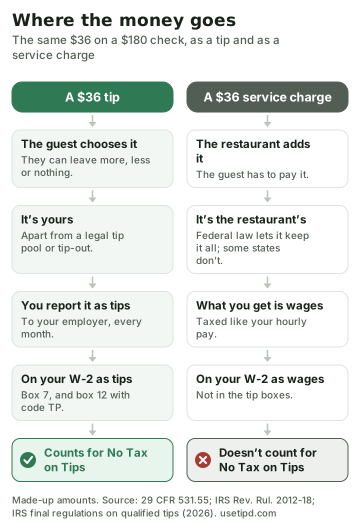
A tip belongs to you. Federal law bars your employer, its managers and its supervisors from keeping any part of it; the only things that can come out are a legal tip pool or tip-out and the card company's actual fee on a card tip. (The details are in can your employer take your tips?)
A service charge is part of the restaurant's sales. In the IRS's words, an employer “may distribute service charges or auto-gratuities to employees in any manner it chooses or may retain all or part.” So it can keep the money, use it to pay the kitchen, or pass it to the servers, unless your state says otherwise (more on that below). Whatever it passes to you is wages, and that changes three things:
- It can count toward your minimum wage. Under federal law, a restaurant can count every dollar of service charge money it pays you toward the minimum wage it owes you. Washington and Michigan are exceptions: there, service charge pay comes on top of the wages you're owed.
- It raises your overtime rate. Service charge pay goes into the regular rate your overtime is figured from. Your tips don't.
- It comes on payday, with taxes taken out. The restaurant withholds income tax, Social Security and Medicare from it, the same as from your hourly pay.
Tip vs. service charge, side by side
| Tip | Service charge | |
|---|---|---|
| Who sets the amount | The guest | The restaurant |
| Whose money it is | Yours, apart from a legal tip pool | The restaurant's, unless your state says otherwise |
| Can a manager keep it? | Never | Federal law allows it |
| You report it to your employer | Yes, every month | No, it's already in your pay |
| Taxes | Income tax, Social Security and Medicare | The same, withheld from your check |
| On your W-2 | Box 7 and box 12, code TP | In your wages, not the tip boxes |
| Counts toward overtime | No | Yes |
| No Tax on Tips deduction | Counts | Doesn't count |
Why it matters for your taxes
The No Tax on Tips deduction lets you take up to $25,000 of reported tips a year off your federal taxable income, from 2025 through 2028. It covers tips only. The law defines a qualified tip as one “paid voluntarily without any consequence in the event of nonpayment,” and the IRS's final rules, issued in April 2026, spell it out: service charges, automatic gratuities and any other mandatory amounts added to a bill “are not qualified tips, even if the amounts are subsequently distributed to employees.”
So the same $36 is worth more to you as a tip than as a service charge. Say $6,000 of your year came from big-party gratuities. As tips, that $6,000 could come off your taxable income; as service charge pay it can't, which at the 12% tax bracket is about $720 more in federal income tax. A server at a restaurant that puts a service charge on every check, and where guests rarely tip on top, may have almost nothing to deduct.
Two more effects. You don't report service charges to your employer as tips, because they're already in your wages; the IRS tells servers to leave them out of their daily tip record. And your W-2 keeps them apart: box 7 and box 12 with code TP show the tips you reported, while service charge pay is counted with your wages. Our guide to W-2 box 12 code TP explains those boxes.
States that make restaurants share it or explain it
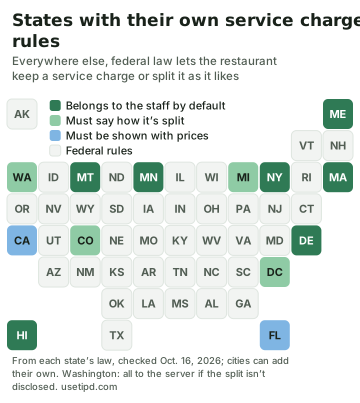
Federal law is only the floor. Twelve states and D.C. have rules of their own, of three kinds.
It belongs to the staff, unless guests are told otherwise
- Massachusetts. A service charge, or any fee a guest would reasonably expect to go to the staff, must go only to the wait staff, service staff and service bartenders, in proportion to the service each gave. A restaurant can keep a “house or administrative fee” only if it tells guests in writing that the fee isn't a tip or a service charge for the staff. Under the state's fee rules, in force since September 2025, a big-party service charge is allowed as long as it goes to the staff and is shown clearly wherever prices appear.
- New York. Any charge on top of food and drink, including one called “service,” is presumed to be a gratuity, and a gratuity must go in full to the staff who served. For banquets and special events, a restaurant can add an administrative charge only if the contract, menu and bill say plainly, in type the size of the text around it and no smaller than 12-point, that it isn't a gratuity.
- Hawaii. A restaurant or hotel that adds a service charge for food or drink must give it to the employees as tip income, or tell the guest clearly that it pays for other costs.
- Minnesota. A mandatory charge a guest could reasonably take as payment for the staff's service counts as a gratuity, which is the employee's own property, unless the restaurant clearly says it isn't. Since January 2025, a restaurant's advertised prices must either include its mandatory fees or clearly show the percentage of any automatic gratuity.
- Delaware. A service charge belongs to the employees who served the guests unless the menu, a sign, the front of the bill or another notice says clearly that all or part of it goes to management.
- Maine. A tip automatically added to the bill must be treated as a tip for the server. At banquets and private clubs, a service charge needs a notice telling the guest it isn't a tip for the staff.
- Montana. A fixed charge added to the bill in place of a tip must go to the non-management employees who prepared or served the food and drink, or be shared through a tip pool agreement. The law has no exception for telling guests otherwise.
The restaurant must say how it's split
- Washington. The menu and the itemized receipt must say what percentage of an automatic service charge goes to the staff who served. The state's Department of Labor & Industries says that if nothing is disclosed, or it's unclear, the whole charge goes to the employee who served. And service charge pay comes on top of the state minimum wage.
- District of Columbia. Since May 2024, a restaurant's service fee can be no more than 20% (25% under a written contract, such as for a banquet). Menus, the website and a sign at the door must explain how it's used, including how much goes to operating costs and how much to the staff, and it can be used only that way. Since January 2026, pay stubs must show service charge pay.
- Colorado. Since January 2026, a restaurant that adds a mandatory service charge must either build it into its prices or show its percentage or amount wherever prices appear, with an accurate description of how it's distributed.
- Michigan. Since February 2025, a restaurant must tell its employees and its customers in writing how it will distribute service charges, and service charges paid to employees come on top of the wages they're owed.
It must be shown with the prices
- California. A restaurant can add a mandatory fee without building it into its prices only if the fee is shown clearly, with what it's for, on the menu and anywhere else prices appear. No state law says who gets it, but a California appeals court ruled in 2019 that a charge called a service charge can still be a gratuity that belongs to the staff, depending on the facts.
- Florida. Since July 1, 2026, a restaurant that adds an automatic charge, such as a service charge, an automatic gratuity or a card surcharge, must show its amount or percentage and what it's for on the menu, contract, website or app, and say on the bill that it's included.
Elsewhere, and in cities
Pennsylvania has a narrower rule for banquets and special events: an administrative charge must be disclosed as not a tip, and the bill must show service charges and tips on separate lines. Rhode Island's law says outright what federal law implies: service charges are the employer's money, not tips.
Cities can add their own. Since April 2026, New York City lets a restaurant add a mandatory gratuity only when it's disclosed clearly and all of it goes to the staff under a written agreement, such as a union contract. Los Angeles hotels must pay service charges in full to the workers who did the service, and Oakland's hospitality employers must pay them to the employees who served.
One thing state law doesn't change: your taxes. Even where a state says the service charge belongs to the staff, the IRS still treats a charge the guest had to pay as a service charge. It's wages on your W-2, and it doesn't count for No Tax on Tips. These are summaries; your state's labor department can tell you how its rule applies to you.
Kitchen fees, health fees and other names
A “kitchen appreciation fee,” a “wellness surcharge,” a “living wage fee” or an “admin fee” is a service charge in the eyes of federal law if the guest has to pay it. It isn't a tip for anyone, and federal law leaves it to the restaurant. Where it can get the restaurant in trouble is state law: in Massachusetts a fee guests would reasonably think goes to the staff has to go to the staff unless the restaurant says otherwise, and in New York a charge for “service” is presumed to be a gratuity. A card surcharge, which covers the restaurant's card fees, isn't money for the staff at all.
What to do at your restaurant
- Ask how the service charge is split, and get the answer in writing: what share goes to servers, to the kitchen and to the house. In Washington, D.C., Colorado and Michigan, the restaurant has to tell guests that anyway.
- Check your pay stub. Service charge pay should show up as wages. Compare it with what your parties were charged.
- Leave service charges out of your tip report. Report what guests chose to leave, including anything they added on top of a service charge.
- Keep your own record of each shift's service charges, separate from your tips, so you can check them against your pay.
- If your state says the money is yours and it isn't reaching you, your state's labor department or attorney general is where to complain.
Tracking tips when your checks have service charges
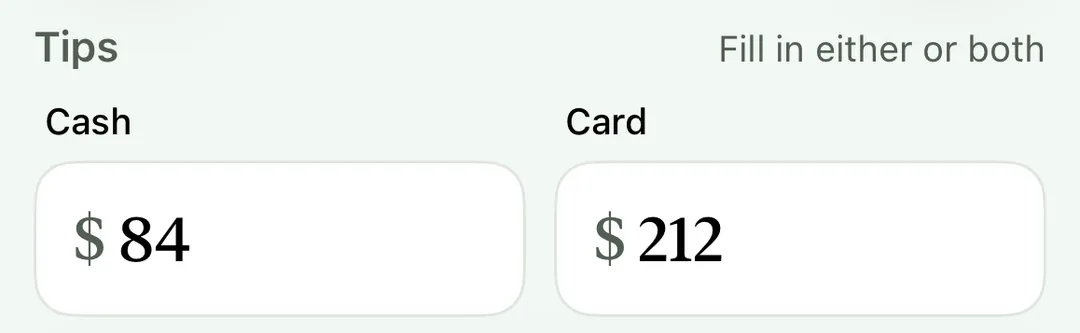
In Tip’d, the tip tracker we make for iPhone, the Cash and Card fields are for tips: what guests chose to leave, including anything added on top of a service charge. Leave the service charge out of them and write it in the shift's note instead (“party of 12, 18% auto-grat, $64”). That keeps your logged tips matching what you report to your employer, keeps the No tax on tips card on the Year screen counting only tips that can qualify, and gives you a list of service charges to check against your pay stub. Logging shifts is free, with no ads and no account.
Questions people ask
Is an automatic gratuity a tip?
No. If the restaurant adds it and the guest can't take it off or change it, it's a service charge, even when the check calls it a gratuity.
Can my restaurant keep the service charge?
Under federal law, yes, all or part of it. In Delaware, Hawaii, Maine, Massachusetts, Minnesota and New York it belongs to the staff unless the restaurant clearly tells guests otherwise, and in Montana it must go to the staff. Colorado, D.C., Michigan and Washington make restaurants say how it's split. The map above shows them all.
A guest added a tip on top of the service charge. Is that mine?
Yes. Anything a guest chooses to leave on top of a service charge is a tip, with every protection a tip has, and it counts for No Tax on Tips.
Do I report service charges as tips?
No. Service charge pay is already in your wages. Report only what guests chose to leave; here's how to report your tips.
Can service charge pay count toward my minimum wage?
Under federal law, yes, all of it. In Washington and Michigan it can't: service charge pay there comes on top of the wages you're owed.
Our card reader won't let guests choose no tip. Are those tips?
Only the part above the minimum the screen forces counts as a tip for No Tax on Tips. The IRS treats a required minimum as a mandatory charge.
Is this legal or tax advice?
It's a plain-language summary of federal and state rules as of October 2026. Your state's labor department, a lawyer or your tax preparer knows your situation; this guide doesn't.
Sources
- IRS Revenue Ruling 2012-18 (the four factors and the 18% large-party example)
- IRS: Tip recordkeeping and reporting (service charges are not tips and are wages)
- IRS Publication 531: Reporting Tip Income and Publication 15 (Circular E)
- 26 U.S.C. 224: Qualified tips and the IRS's final regulations, T.D. 10044 (Federal Register, April 13, 2026, § 1.224-1(c)(4) and its examples)
- IRS: 2026 General Instructions for Forms W-2 and W-3
- 29 CFR 531.55: Amounts not received as tips and U.S. Department of Labor, Fact Sheet #15
- Massachusetts: G.L. c. 149, § 152A and the Attorney General's fee rules, 940 CMR 38.00
- New York: 12 NYCRR 146-2.18 and 146-2.19
- Hawaii: HRS § 481B-14
- Minnesota: Minn. Stat. § 177.23, § 177.24 and § 325D.44
- Washington: RCW 49.46.160 and Labor & Industries: Tips and service charges
- District of Columbia: D.C. Code § 47-2908 and § 32-1008
- Delaware: 19 Del. C. § 902; Maine: 26 M.R.S. § 664; Montana: MCA § 39-3-201
- Colorado: HB25-1090, Protections Against Deceptive Pricing Practices; Michigan: MCL 408.934d
- California: SB 1524 (2024), the Attorney General's hidden-fees guidance and O'Grady v. Merchant Exchange Productions (2019)
- Florida: Fla. Stat. § 509.214 and SB 606 (2025)
- Pennsylvania: 34 Pa. Code § 231.114; Rhode Island: R.I. Gen. Laws § 28-14.1-3
- New York City: Restaurant surcharges rule (2026); Los Angeles: Hotel Worker Minimum Wage Ordinance; Oakland: minimum wage and labor laws
- Square: Summer Restaurant Report, August 2024 (service fees on 3.7% of restaurant transactions)