How to Work Out Your Real Hourly Pay with Tips (and What Servers Actually Make)
Published
Quick answer: Your real hourly pay is your hours times your hourly wage, plus your cash and card tips and any service charge pay, minus what you tipped out, divided by the hours you worked. A 6-hour dinner at $2.13 an hour with $260 in tips and a $40 tip-out is $232.78, or $38.80 an hour. Count every hour you work, including side work, on the clock or not. Under federal law your wage plus tips must reach at least $7.25 an hour over the workweek or the employer pays the difference, and overtime for a tipped employee is figured on the full minimum wage. In the BLS's May 2025 survey, the typical server made $16.94 an hour with tips and the average was $19.26. Track every shift and the number stops being a guess.
Tip’d, our free iPhone tip tracker, works this out for every shift you log and shows it for your week, your month and each job.
Ask a server what they make and you'll hear a number for the night: “I walked with $260.” Ask what they make an hour and the answer takes longer, because the hourly wage is on one piece of paper, the tips are in a pocket, the tip-out went to the bar, and nobody wrote down the hours. The hourly rate is the number that tells you whether a job, a section or a schedule is worth it, and it's the one the law cares about. Here's how to work it out, what gets in the way, and what servers make on average.
The formula
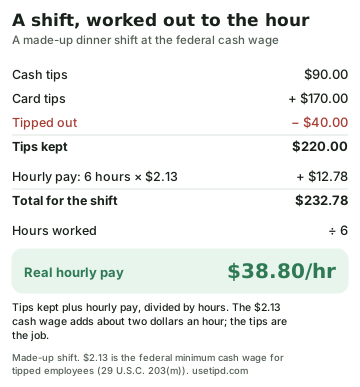
Real hourly pay = (hours × hourly wage + cash tips + card tips − tip-out) ÷ hours. If the restaurant pays you service charges, add them on the wage side.
Take a 6-hour dinner shift at the federal cash wage of $2.13. You made $90 in cash and $170 on cards and tipped out $40. Tips kept: $220. Hourly pay: 6 × $2.13 = $12.78. Total: $232.78. Divided by 6 hours: $38.80 an hour.
Three rules for doing it right:
- Use the tips you kept, not the tips you were given. The tip-out is gone; it isn't your pay. (How tip-outs are figured is a guide of its own: how to calculate your tip-out.)
- Count every hour you work, on the clock or off. Rolling silverware before open and resetting the dining room after close are work. A 6-hour shift that's really 7, with an hour of side work off the clock, is $33.25 an hour, not $38.80.
- Leave service charges out of the tips. An automatic gratuity the restaurant pays you is wages, not a tip. Count it as pay, not tips, so your tip figures stay right for your taxes.
Hours are the number a tip total hides
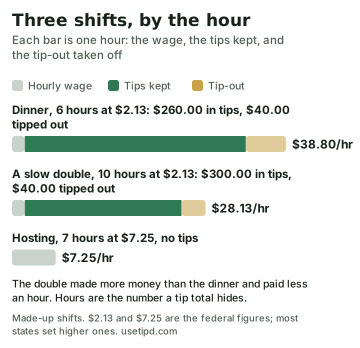
A slow double, 10 hours for $300 in tips, feels like a better night than a 6-hour dinner for $260. It isn't: $28.13 an hour against $38.80. That's the whole case for tracking hours and not just tips. It's also why a host shift at $7.25 with no tips can be worth taking when the alternative is a dead Tuesday on $2.13, and why one job might pay $45 an hour on a Friday and $18 on a Monday.
Once you have a few weeks of shifts, compare like with like: dinner against dinner, one job against the other, Friday against Sunday. The differences are what decide which shifts to ask for.
The floor: minimum wage for tipped workers
Federal law lets a restaurant pay a tipped employee as little as $2.13 an hour in cash and count up to $5.12 an hour of tips toward the $7.25 federal minimum wage. That's the tip credit, and it comes with the most useful sentence in this guide: if your cash wage plus your tips don't add up to at least $7.25 an hour over the workweek, the employer has to pay the difference, on the regular payday. It's measured by the week, not the shift, so a dead Tuesday can be carried by a good Friday, but a week of dead nights can't fall below the floor.
Two more conditions. The employer has to tell you it's taking a tip credit before it does, including the cash wage, the credit and that you keep all your tips apart from a valid tip pool; an employer that never told you can't take the credit at all. And the tips that count are the tips you keep: what you tip out to others counts for them, not for you.
Most states set a higher floor, and seven states allow no tip credit at all: Alaska, California, Minnesota, Montana, Nevada, Oregon and Washington pay tipped workers the full state minimum wage before tips. Our guides list every state's cash wage and what servers make there and the 2027 raises.
Overtime, side work and other things that lower your rate
- Overtime is figured on the full minimum wage, not your cash wage. Past 40 hours in a week, a tipped employee at the federal rates is owed 1.5 × $7.25 = $10.875 an hour, minus no more than the $5.12 tip credit taken on a regular hour: about $5.76 an hour in cash (the Labor Department's own example drops the half cent: $10.87 − $5.12 = $5.75). An employer that pays $2.13 × 1.5 = $3.20 for overtime is underpaying you. Service charge pay goes into the rate overtime is figured on; tips above the tip credit don't have to be.
- Side work is hours worked. Under federal rules, work your employer requires or allows is paid time, including prep before the shift and staying after it to finish, and a rule against working off the clock isn't enough if the employer knows, or should know, that the work gets done. Those hours belong on your time card and in your count. The 2021 federal rule that barred the tip credit for side work beyond 20% of the week's hours, or beyond 30 minutes at a stretch, was struck down by a federal appeals court in 2024 and taken off the books that December. The rule today is simpler: side duties that are part of a tipped job, like setting tables and making coffee, can be paid at the tipped wage under federal law, but a separate untipped job at the same place, like a maintenance shift, has to be paid the full minimum wage for those hours.
- Walkouts, breakage, register shortages and uniforms can't come out of your pay when the employer takes a tip credit, because you're already at the minimum, and your tips are yours under federal law regardless. If they do, your real rate has been cut below the legal floor.
If your pay falls short on any of these, can your employer take your tips? covers what to do and where to complain.
What servers actually make an hour
The best public number comes from the Bureau of Labor Statistics, which asks employers what they pay, tips included. In its May 2025 survey, published in May 2026, the typical server made $16.94 an hour with tips (the median), and the average was $19.26; a server at the 90th percentile made $31.12 an hour and one at the 10th, $8.70. Bartenders: a median of $16.51 and an average of $19.61, with a wider top end ($35.47 at the 90th percentile). Hosts had a median of $15.00, and bussers and barbacks (the BLS's dining room attendants and bartender helpers) $16.34. The highest-paying places for servers were Hawaii ($32.82 an hour on average), Washington ($29.13) and the District of Columbia ($28.61); the lowest state was Louisiana, at $10.75. Our guide to what servers make in every state has all 50 and D.C., and finds servers in the states that allow the federal $2.13 cash wage averaging about $15.15 an hour, against about $21.20 everywhere else.
Those figures rest on what employers report, so tips that never got reported likely aren't in them. Industry data, drawn from full-service restaurants, run higher. Toast, looking at servers at full-service restaurants on its payroll system in September 2024, found a median hourly wage of $6.24 and a median of $21.48 an hour in tips. A National Restaurant Association survey of 2,325 full-service restaurants in January 2022 (a preliminary analysis) put the median server at $27 an hour, $7 in wages and $20 in tips. A payroll firm's 2025 data from 110 Washington restaurant locations showed directly tipped employees, mostly servers and bartenders, reporting $28.06 an hour in tips alone, generally after tip-outs, in a state with no tip credit. None of these is a representative national figure: two come from one company's customers, and one from an industry group's survey of its own sector.
Compare hourly figures, not yearly ones. Jobs in restaurants and bars average about 25 hours a week, and the BLS's yearly figures assume 2,080 hours, which most servers don't work. Your own rate, shift by shift, is the number that counts.
Why the paycheck looks so small
Your hourly rate is before taxes, and for a tipped worker the taxes land in an odd place. Tax isn't withheld from the tips themselves. Your employer counts the tips you reported when it figures the withholding, then takes it out of your regular pay, and on a cash wage of $2.13 there often isn't enough pay to take it from. A 30-hour week at $2.13 is $63.90 of wages. Social Security and Medicare on $1,100 of tips reported in a busy week, at 6.2% and 1.45%, come to $84.15. That's more than the wages, so the check is $0 before income tax on your tips even gets a turn.
When that happens, the IRS's order is fixed: the taxes on your wages first, then Social Security and Medicare on your tips, then income tax on your tips. Whatever can't be collected goes one of two ways. Social Security and Medicare tax the employer couldn't collect by the 10th of the month after you reported the tips is reported on your W-2 in box 12 with codes A and B, and you pay it with your return. Income tax keeps coming out of later checks until the end of the year, and if it never catches up you may owe the tax with your return, plus a penalty for underpaying estimated tax. So a tipped worker whose checks keep coming out at $0 may owe at filing time, at least the Social Security and Medicare that couldn't be collected. To head that off, hand your employer money to cover the shortfall any time before the end of the year, or make estimated tax payments. A new W-4 helps only when there's pay to take withholding from: the 2026 form's Deductions Worksheet has a line (1a) for your expected qualified tips, which lowers withholding through Step 4(b), and Step 4(c) adds extra withholding.
Two more things about take-home pay:
- The No Tax on Tips deduction lowers federal income tax only. Social Security and Medicare still apply to the tips you report (generally, once they reach $20 in a month at one job), and the deduction is capped at $25,000 a year. See the No Tax on Tips deduction.
- Your state has its own rules. Most states don't give the federal deduction: as of August 10, 2026, Ballotpedia counted ten that conformed to it, Georgia partly, and 31 that didn't; nine have no income tax on wages.
So your real hourly pay is a gross figure. No law sets an “hourly pay with tips” you're owed; the federal test is the minimum wage one above, wage plus tips averaged over the workweek. For take-home, take your rate and subtract 7.65% for Social Security and Medicare, plus your federal, state and local income tax.
Tracking it
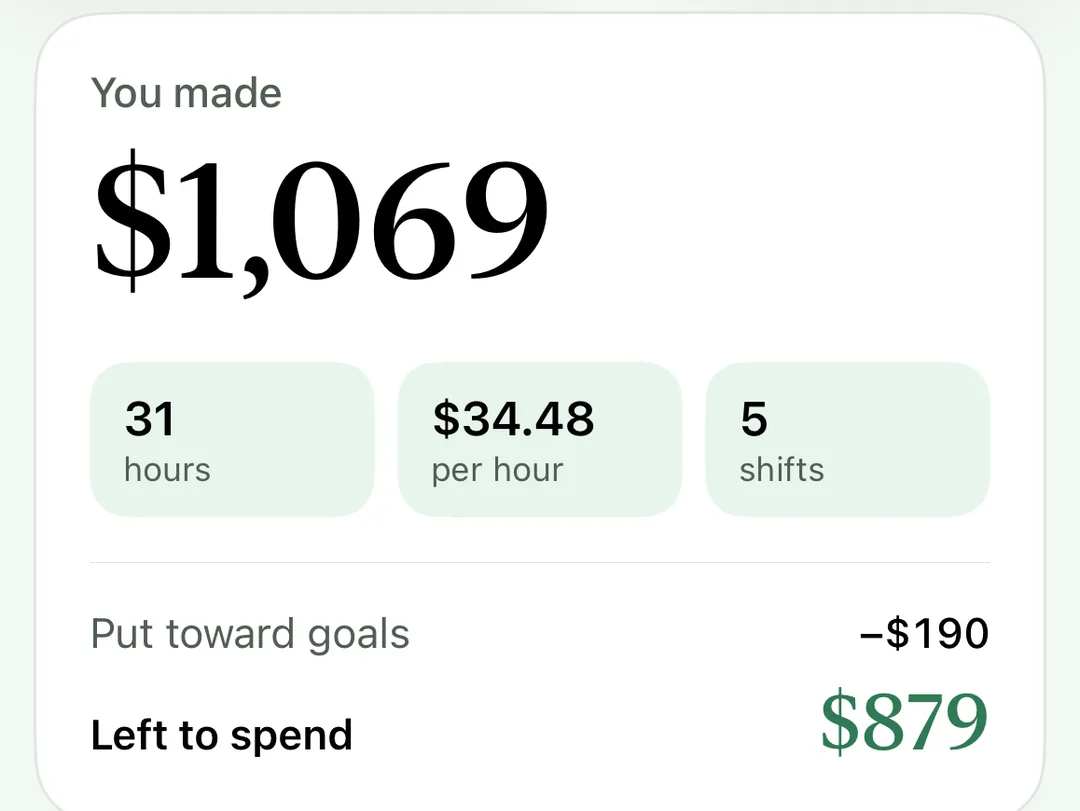
A notebook works: date, job, hours, cash, card, tip-out, and the arithmetic once a week. A spreadsheet works. Tip’d, the free iPhone tip tracker we make, does the arithmetic for you: log a shift's hours, cash tips, card tips and tip-out in a few taps, and the shift, the week, the month and your all-time rate show what you really made an hour. Each position carries its own wage, so a host shift and a bartending shift at the same restaurant come out right, and Trends compares your rate by job, position, shift and day of the week. Logging shifts is free, with no ads and no account.
Questions people ask
Should I count my hourly wage at all? It's $2.13.
Yes. It's small, but it's real, and on a long shift it adds up. More to the point, it's what makes the minimum wage rule work: your wage plus your tips is the number that has to reach the minimum.
Do I count the tip-out?
Subtract it. Your real hourly pay is what you kept. The same goes for your taxes: you report the tips you kept, not the tips you were handed.
Is my hourly pay before or after taxes?
Before. The number above is your gross hourly rate, which is what you compare jobs with and what the minimum wage rule measures. What you take home is lower, as the paycheck section explains.
What about a shift with no tips?
Your rate is your wage. Count those hours too; they're part of your week's average and they're why a host shift can beat a slow server shift.
Is this legal or tax advice?
It's a plain-language summary of federal rules and public data as of October 2026. Your state's labor department or your tax preparer knows your situation; this guide doesn't.
Sources
- Bureau of Labor Statistics, Occupational Employment and Wage Statistics, May 2025 (released May 15, 2026): Waiters and Waitresses (and by average wage), Bartenders, Hosts and Hostesses, Dining Room and Cafeteria Attendants and Bartender Helpers, the state data file (the lowest state) and the technical notes (wages include tips); Food services and drinking places: average weekly hours
- Toast: Restaurant Trends Report, December 2024 (median wage and tips per hour at full-service restaurants, September 2024; vendor data)
- National Restaurant Association: Tipped employee research, January 2022 (an industry survey of 2,325 full-service restaurants; a preliminary analysis) and Back Office: What Washington servers and bartenders really earn, 2025 (payroll data from 110 Washington locations, hosted by the Washington Hospitality Association)
- U.S. Department of Labor, Fact Sheet #15: Tipped Employees Under the FLSA (the $2.13 cash wage, the $5.12 tip credit, the workweek make-up rule, the notice, overtime, walkouts and breakage)
- U.S. Department of Labor, overtime example for a tipped employee and 29 CFR 531.60 (tips above the tip credit stay out of the regular rate)
- 29 CFR 531.56 (dual jobs, as restored by 89 FR 101884, December 17, 2024) and Restaurant Law Center v. U.S. Department of Labor (5th Cir., October 29, 2024)
- U.S. Department of Labor, Fact Sheet #22: Hours Worked, 29 CFR 785.11, 785.13 (a rule against off-the-clock work isn't enough) and 785.24; Fact Sheet #2: Restaurants and Fast Food Establishments (uniforms)
- U.S. Department of Labor: Minimum wages for tipped employees by state (July 1, 2026)
- IRS Publication 505: Tax Withholding and Estimated Tax (2026) and Publication 531: Reporting Tip Income (how tax on tips is withheld, the order when pay runs short, uncollected tax)
- IRS Topic 761: Tips, withholding and reporting, Topic 751: Social Security and Medicare withholding rates and the 2026 Forms W-2 and W-3 instructions (box 12 codes A and B)
- IRS Publication 15 (2026) (the deduction doesn't change Social Security and Medicare tax on tips) and Form W-4 (2026)
- Ballotpedia: State implementation of the No Tax on Tips deduction (as of August 10, 2026; a secondary source)