How to Calculate Your Tip-Out: Percent of Sales, Percent of Tips, or Points
Published
Quick answer: A tip-out is figured one of three ways. A percent of your sales (often 0.5% to 2.5% of total sales to each support role, or a percent of bar or food sales), a percent of your tips (commonly 20% to 40% of your tips all together), or points in a pool (the pool divided by everyone's points gives the value of a point). Multiply, add up the roles, and subtract from your tips: what's left is what you keep and what you report. A tip-out on sales costs the same dollars on a night of bad tips as on a good one, so it takes a bigger share when tips are small. Federal law lets a restaurant require a tip-out to coworkers who usually get tips (and to the kitchen too, if it pays the full minimum wage before tips), never to managers, and your wage plus the tips you keep still has to reach the minimum wage.
Tip’d, our free iPhone tip tracker, has a Tipped out field on every shift, so what you log is what you kept and what you report.
At the end of the shift you hand part of your tips to the bussers, the bar, the runner, the host stand. Everyone calls it the tip-out, and almost nobody can say exactly how their restaurant figures it. That matters, because the method decides what a night of bad tips costs you, and because the number you're left with is the number you report to the IRS. Here's the math, the three ways it's done, and what the law says about it.
Tip-out, tip share, tip pool
The words get mixed up. A tip-out (or tip share) is when you keep your own tips and hand set amounts to the people who supported your tables. A tip pool is when all or part of everyone's tips go into one pot that's divided by hours, percentages or points. Many restaurants do both: a tip-out from servers that funds a pool for the support staff. The math below covers all of them.
Method 1: a percent of your sales
The restaurant sets a percentage for each role and applies it to what you sold, not what you were tipped. Sometimes it's a percent of your total sales; often the bartender gets a percent of your bar sales and the runner a percent of your food sales.
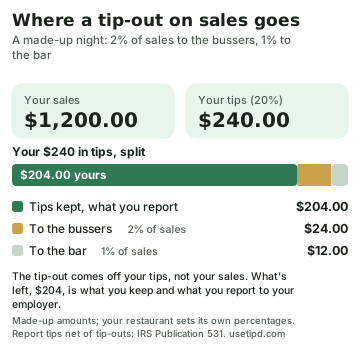
The formula: your sales × the role's percentage, for each role, added up.
Say you sold $1,200 and the house tips out 2% of total sales to the bussers and 1% to the bar. That's $24 + $12 = $36, whatever your tips were. If guests tipped 20%, you made $240 and keep $204.
What's typical? We found no independent survey, only rules of thumb published by POS, payroll and tip-payout companies, plus a consultant and an app. Homebase puts bussers at 1% to 2.5% of sales, bartenders at 1% to 2% of total sales, food runners at about 1% and hosts at 0.5% to 1%. Toast gives bartenders 5% to 10% of a server's alcohol sales and bussers 1% to 2% of total sales. A restaurant consultant quoted by Restaurant Business in 2015 put real-world totals at 3% to 7% of net sales, with steakhouses at the top, and the tip-out app Cashout says most full-service servers pay out 2% to 6% of net sales.
Two questions to ask about the base:
- Net or gross sales? Toast and TipHaus figure a sales-based tip-out on net sales: the subtotal after comps, discounts and voids, and before sales tax. Some houses use gross, which can include things you never got tipped on, so ask which line on your checkout slip the percentage is taken from.
- Which categories? If the bartender's share is on bar sales only, a table that drank water doesn't tip out to the bar.
Method 2: a percent of your tips
The formula: your tips × the role's percentage, for each role.
7shifts' example: a server with $100 in tips gives 15% ($15) to the bartender, 10% ($10) to the food runner and 5% ($5) to the busser, and keeps $70. The overall share is what to look at. Published rules of thumb put the total at 20% to 40% of your tips: eTip's 2026 chart says 20% to 30% in a casual full-service place and 30% to 40% in fine dining, where there are more hands on each table.
The question to ask here is what counts as “your tips.” Automatic gratuities and service charges on big parties are a common argument. Under federal law a mandatory service charge is the restaurant's money, paid to you as wages, not a tip, so whether it belongs in the tip-out base is usually the restaurant's call; some states, including Massachusetts and New York, treat service charges as tips. (See service charge vs. tip.)
Method 3: points in a pool
Each position gets points; the pool is divided by everyone's points to get the value of one point; each person gets their points times that value.
The formula: value of a point = total pool ÷ total points; your share = your points × that value.
Toast's example: a server is worth 6 points, a bartender 4, a busser 2 and a dishwasher 1, so 13 points in all (a pool that includes a dishwasher is legal federally only when everyone gets the full minimum wage before tips). A $1,000 pool is $76.92 a point: $461.54 to the server, $307.69 to the bartender, $153.85 to the busser. Many systems weight the points by hours, so a server who worked 6 hours at 2 points an hour has 12 points and one who worked 4 hours has 8.
Points reward the role, not the night. A server who sold twice as much as the next one gets the same share, which is the complaint 7shifts itself lists against the method.
The problem with a night of bad tips
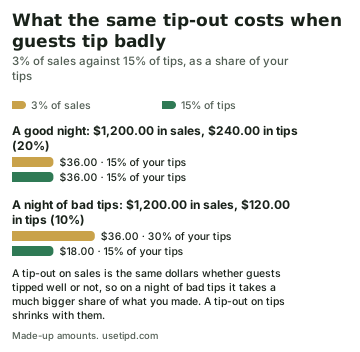
On a 20% night, 3% of sales and 15% of tips are the same $36. On a 10% night, the sales-based tip-out is still $36, now nearly a third of what you made, while the tips-based one falls to $18. Some of the companies that describe sales-based tip-outs admit this: Homebase says it “can penalize servers who get stiffed,” 7shifts says it “might be unfair to servers,” and eTip says it “feels unfair to the server” when tips run low. In the worst case it goes negative. The Restaurant HQ's example is a server with $500 in sales whose tip-outs add up to $42 (the page says $43) however the night went; if the tables left her $75, she keeps $33. A waiter's 2009 account in KQED describes a $500 check with a $20 tip where the house's sales-based tip-outs came to about $31, so serving the table cost him money.
Restaurants choose sales-based tip-outs because they're predictable and because they protect the support staff from a bad tipper. That's a fair goal. The cost of it lands on you, so it's worth knowing which method your restaurant uses before a bad night, not after.
What the law allows
Under federal law, your restaurant can require a tip-out or a tip pool. The limits are on who gets the money and on what's left for you:
- If you're paid less than the full minimum wage before tips (a tip credit, with a cash wage as low as $2.13), a required tip-out can go only to coworkers who customarily and regularly get tips: bussers, bartenders and service bartenders, barbacks and sommeliers are on the Labor Department's list, and hosts or food runners count where they customarily get tips. Not cooks, dishwashers or prep cooks. The restaurant has to tell you the contribution amount, and only the tips you keep after tipping out count toward your minimum wage.
- If you're paid the full minimum wage before tips, the pool can include the kitchen too.
- Never managers or supervisors, whatever the pay. Anyone whose main job is running the place or a department, who directs at least two full-time employees or the equivalent and who has a real say in hiring and firing is a manager under the duties test, and so is an owner of 20% or more who helps run it; a manager can't take a cut of a tip-out or pool even on nights they bartend, though they can keep tips their own customers hand them directly; the Labor Department said so in an opinion letter in September 2026, and calling it a “tip-out” instead of a pool changes nothing. A manager can be made to pay into a pool, never to take from it.
- There's no federal cap on the percentage. The Labor Department used to treat 15% of tips, or 2% of sales, as the most it would accept without asking questions, but it dropped those figures in 2011, and the rule now says plainly that the law sets no maximum. The federal limit is the floor: your cash wage plus the tips you keep must still reach the minimum wage over the workweek, and your employer can never keep any tips itself. An employer that does owes the tips back, plus any tip credit it took, plus the same again in damages, and can be fined up to $1,409 per violation.
- Percent of sales isn't addressed. No federal rule says a sales-based tip-out is allowed or not. The Labor Department has described them in opinion letters since 1983 without objecting, and a California court upheld a 1%-of-sales pool in 2009 without discussing the basis. What a sales-based tip-out can't do is take you below the minimum wage.
States add their own rules. A few that matter:
- Delaware caps a required pool at 15% of your tips, and allows one only when more than one direct-service employee (a busser or bartender, for example) serves the same customer.
- Washington and Montana say you can't be made to put in more than you received in tips, which rules out a sales-based tip-out that exceeds your tips on a bad night.
- Minnesota doesn't allow required tip pools at all: sharing has to be voluntary.
- New York limits contributions to what's “customary and reasonable,” lists who may share (bussers, barbacks, runners and hosts who seat guests, among others), and requires the restaurant to keep records of the pool for six years and let you look at them.
- Massachusetts allows pools only among wait staff, service employees and service bartenders, and no one who had managerial responsibility that day.
- California treats a required pool as legal when it covers the chain of service, which the courts have read to include the kitchen, but never owners, managers or supervisors, and the pool must be fair and reasonable; since January 2026 the Labor Commissioner can cite a restaurant for taking tips.
If your tip-out breaks these rules, the federal Wage and Hour Division takes confidential complaints (1-866-487-9243), your state's labor department does too, and retaliating against you for complaining is itself illegal. Our guide can your employer take your tips? goes deeper.
Tip-outs and your taxes
The IRS has one rule here, and it works in your favor: you report the tips you keep. Publication 531 says it plainly: “If you participate in a tip-splitting or tip-pooling arrangement, report only the tips you receive and retain. Don't report to your employer any portion of the tips you receive that you pass on to other employees.” The busser and the bartender report what you gave them. The same rule applies on your tax return, and Social Security and Medicare tax (6.2% and 1.45%) are withheld on the tips you report, so a tip-out you subtract is a tip-out you aren't taxed on.
Three things follow:
- Your daily tip record should show the tip-out. The IRS's list for the record is the date, your cash tips, your card tips, any noncash tips, and “the amount of tips you paid out to other employees through tip pools or tip splitting, or other arrangements, and the names of the employees to whom you paid the tips.” Write down who got what.
- Report the net figure to your employer by the 10th of the next month, for any job where your tips reached $20 in the month. That number is what lands in box 7 of your W-2 and, from 2026, in box 12 with code TP, the figure the No Tax on Tips deduction is built on. If your employer's system records your gross tips and ignores your tip-out, say so before the W-2 goes out: fixing a W-2 takes a corrected form (W-2c) from the employer or, if the employer won't correct it, a Form 4852 substitute filed with your return, and Form 4137 can only add tips you didn't report, never subtract. The IRS's own advice is to ask the employer first and, if it isn't fixed by the end of February, to call the IRS.
- Allocated tips are where records save you. A restaurant that normally has more than ten employees on a typical day compares the tips everyone reported with 8% of its gross receipts (or a lower rate the IRS approved); if they fall short, it allocates the difference to directly tipped employees who reported less than their share, in box 8 of the W-2. You can report less than box 8 only if your records show you actually received less. The IRS's own example in its tips FAQ is a server who tips out 15% to the busser and 5% to the bartender: keep a daily record of the tips you got and the amounts you tipped out, because “if you don't have records or if you have inadequate records, you must report the full amount in box 8.”
The people you tip out report what they received, and under the final rules issued in April 2026, tips that reach them through a tip pool can be qualified tips too, if their job is on the Treasury list (restaurant support and kitchen jobs are) and they aren't managers or supervisors. More on reporting in how to report cash tips.
Keep your own record
Every method above leaves you with one number that matters: what you kept. Tip’d, the free iPhone tip tracker we make, has a Tipped out field on every shift, next to cash tips and card tips. Enter what you handed over, and the shift's total, your real hourly pay and your week are figured on what you kept; put who got what in the shift's note, and your log holds the tips, tip-outs and names the IRS's daily record asks for (add any noncash tips to the note). The year's spreadsheet export lists tipped out and tips kept on every shift, which is your proof if box 8 ever shows up on a W-2, and your tip-out percentage for the month is one division away. Logging shifts is free, with no ads and no account.
Questions people ask
Can my restaurant make me tip out?
Under federal law, yes: to coworkers who customarily get tips (and to the kitchen too, if you're paid the full minimum wage before tips), never to managers, and never so much that your wage plus the tips you keep fall below the minimum. Minnesota is the main exception: there, tip sharing has to be voluntary; Delaware and some other states limit required pools.
Do I still tip out on a table that left nothing?
If your tip-out is a percent of sales, yes: the house's share is figured on what the table bought. If it's a percent of tips, a $0 tip means a $0 tip-out on that table. Ask your manager how walkouts are handled; many policies don't say.
Can cooks and dishwashers be in my tip-out?
Only if your restaurant pays you the full minimum wage before tips. If it takes a tip credit, a required tip-out can go only to coworkers who customarily get tips. Some states are stricter: in Massachusetts the pool stops at wait staff, service employees and service bartenders whatever you're paid.
How do I work out my real tip-out percentage?
Divide what you tipped out by your tips. $36 on $240 is 15%; $36 on $120 is 30%. Track it for a month and you'll know what your restaurant's policy actually costs.
Is this legal or tax advice?
It's a plain-language summary of federal and selected state rules as of October 2026, with the percentages POS and payroll companies publish. Your state's labor department, a lawyer or your tax preparer knows your situation; this guide doesn't.
Sources
- 29 U.S.C. 203(m)(2) and 216; 29 CFR 531.52, 531.54 (tip pools; “does not impose a maximum contribution percentage”) and 578.3 (the $1,409 penalty)
- U.S. Department of Labor, Fact Sheet #15, the Field Operations Handbook, chapter 30 (only tips you keep count toward the minimum wage; which jobs are tipped), opinion letter FLSA2026-13 (September 7, 2026; managers), opinion letters FLSA-856 (November 23, 1983; a 2%-of-sales pool) and FLSA-900 (May 26, 1987; hosts) and the 2011 rule that dropped the 15% and 2% figures (76 FR 18832); how to file a complaint
- States: 19 Del. C. § 902; Washington L&I policy ES.A.12; MCA 39-3-218; Minn. Stat. § 177.24; 12 NYCRR 146-2.14 to 2.17; Mass. G.L. c. 149, § 152A; Cal. Labor Code § 351, the Labor Commissioner's tips FAQ Budrow v. Dave & Buster's (2009) and Etheridge v. Reins International California (2009) (the kitchen)
- IRS Publication 531: Reporting Tip Income (report only the tips you keep; what the daily record holds), IRS: Tip recordkeeping and reporting and the IRS tips FAQ (allocated tips and records)
- IRS: 2026 General Instructions for Forms W-2 and W-3, If your W-2 is wrong, Form 4852, Form 4137 and the Form 8027 instructions (the 8% rule)
- T.D. 10044, the final regulations on qualified tips (§ 1.224-1(c)(1), (c)(2) and (c)(10): the listed jobs, tips received through a tip pool, and managers)
- Percentages and methods, from the companies' own guides: Toast and Toast's POS help, 7shifts, Homebase, Restaurant365, Square, TouchBistro, eTip, TipHaus and Cashout
- Restaurant Business: Can tip outs be mandated? (December 2015; the consultant's 3% to 7% of net sales), The Restaurant HQ: What is a tip out? and KQED: Tipping, down and out (February 2009)