
Does Your State Tax Your Tips? No Tax on Tips, State by State (2026)
Published
Quick answer: Probably, yes. The federal No Tax on Tips deduction lowers only your federal income tax, and most states start their own tax from a line that comes before it. On 2025 state returns, only Arizona, Colorado, Idaho, Iowa, Montana, North Dakota and Oregon let you take it. For 2026 returns, filed in 2027, D.C., Hawaii, Indiana, Michigan and New York join them, and Georgia exempts up to $1,750 of tips. Nine states have no income tax on wages. Everywhere else, tips are taxed on your state return, as of October 18, 2026.
Tip’d, our free iPhone tip tracker, adds up the tips you kept this year and compares them with the $25,000 federal limit on its Year screen.
The No Tax on Tips deduction lets you take up to $25,000 of reported tips off your federal taxable income each year from 2025 through 2028. Then you get to your state return, and in most states the tips are right back on it. The deduction is federal law. Each state decides for itself whether to follow it, and most haven't.
We checked every state with an income tax against its own tax department, forms or laws, for the 2025 returns filed this year and the 2026 returns you'll file in 2027. Here's where your state stands, why, and what to do about it.
The short answer
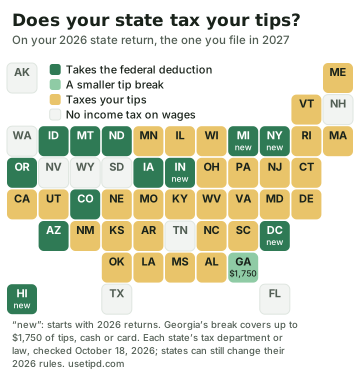
- 7 states let you take the deduction on 2025 returns: Arizona, Colorado, Idaho, Iowa, Montana, North Dakota and Oregon.
- 5 more join them for 2026 returns: D.C., Hawaii, Indiana, Michigan and New York.
- Georgia exempts up to $1,750 of tips a year, cash or card, from 2026 through 2028, a much smaller break than the federal one.
- 9 states don't tax wages at all: Alaska, Florida, Nevada, New Hampshire, South Dakota, Tennessee, Texas, Washington and Wyoming. Your tips aren't taxed there either way.
- The other 29 states tax your tips on your state return, for 2025 and, as things stand, for 2026.
Its also only on fed taxes fyi so unless your city/state adopted it too its only for your federal.
Why most states still tax your tips
It comes down to where your state starts. Most state returns begin with a number copied from your federal return, and the tip deduction comes after the number most of them copy.
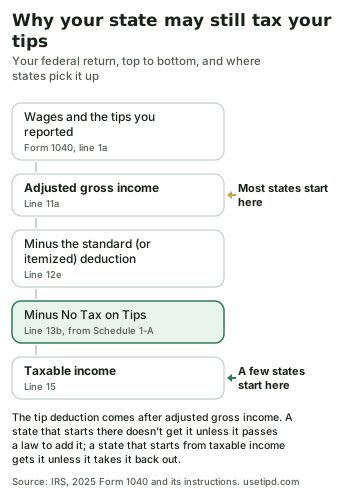
On the 2025 Form 1040, the No Tax on Tips deduction goes on line 13b, from Schedule 1-A, after your adjusted gross income on line 11a. Most states start from adjusted gross income, so the deduction never reaches them. Nebraska's Department of Revenue put it plainly: the new deductions “are taken after the computation of the federal AGI.” Those states would have to pass a law adding a deduction of their own, as D.C., Indiana, Michigan and New York did for 2026.
A few states start from federal taxable income, line 15, which already has the tip deduction taken out. Colorado, Iowa, Montana and North Dakota get it automatically. Idaho and Oregon start from adjusted gross income but let you take the same deduction on the state return. South Carolina started from taxable income for 2025 but hasn't adopted the deduction, so it makes you add it back. A handful of states, like Pennsylvania and New Jersey, don't start from your federal return at all and tax tips as wages under their own rules.
Every state, 2025 and 2026
As of October 18, 2026. “Yes” means you can take the federal tip deduction, or a state copy of it, on your state return.
| State | 2025 return | 2026 return |
|---|---|---|
| Alabama | No | No |
| Alaska | No tax on wages | No tax on wages |
| Arizona | Yes | Yes |
| Arkansas | No | No |
| California | No | No |
| Colorado | Yes | Yes |
| Connecticut | No | No |
| Delaware | No | No |
| District of Columbia | No | Yes |
| Florida | No tax on wages | No tax on wages |
| Georgia | No | Up to $1,750 of tips |
| Hawaii | No | Yes |
| Idaho | Yes | Yes |
| Illinois | No | No |
| Indiana | No | Yes, 2026 only so far |
| Iowa | Yes | Yes |
| Kansas | No | No |
| Kentucky | No | No |
| Louisiana | No | No |
| Maine | No | No |
| Maryland | No | No |
| Massachusetts | No | No |
| Michigan | No | Yes, 2026 to 2028 |
| Minnesota | No | No |
| Mississippi | No | No |
| Missouri | No | No |
| Montana | Yes | Yes |
| Nebraska | No | No |
| Nevada | No tax on wages | No tax on wages |
| New Hampshire | No tax on wages | No tax on wages |
| New Jersey | No | No |
| New Mexico | No | No |
| New York | No | Yes |
| North Carolina | No | No |
| North Dakota | Yes | Yes |
| Ohio | No | No, a bill is pending |
| Oklahoma | No | No |
| Oregon | Yes | Yes |
| Pennsylvania | No | No |
| Rhode Island | No | No |
| South Carolina | No | No |
| South Dakota | No tax on wages | No tax on wages |
| Tennessee | No tax on wages | No tax on wages |
| Texas | No tax on wages | No tax on wages |
| Utah | No | No |
| Vermont | No | No |
| Virginia | No | No |
| Washington | No tax on wages | No tax on wages |
| West Virginia | No | No |
| Wisconsin | No | No |
| Wyoming | No tax on wages | No tax on wages |
If your state takes the deduction
In most of these states the cap, the income limits and the list of tipped jobs are the federal ones, so the amount is whatever you deducted on your federal Schedule 1-A. How you claim it differs:
- Colorado, Iowa, Montana and North Dakota: nothing to do. Your state return starts from federal taxable income, which already has the deduction taken out.
- Idaho: Form 40 carries over federal lines 13a and 13b (the tip deduction is in 13b) with your other deductions. Idaho made this retroactive to 2025 in early 2026, so check that a 2025 return filed early got it.
- Oregon: claim the same amount as a subtraction on Schedule OR-ASC, code 390. Part-year residents and nonresidents use their own codes, and nonresidents count only tips earned working in Oregon.
- Arizona: it's a subtraction on the full Form 140 (not Form 140A or 140EZ), under other subtractions. Arizona allowed it on 2025 returns and wrote it into law in 2026; if you filed without it, you can amend.
- New for 2026: Hawaii updated its tax code to include the federal deduction; Indiana and Michigan passed their own deductions equal to the federal one (Indiana's is for 2026 only unless it's extended, Michigan's runs through 2028); New York's subtraction is up to $25,000, as far as you're allowed it federally; and D.C. added one in its 2027 budget law, in effect since October 2, 2026. Their 2026 forms aren't out yet, so look for the line when you file.
- Georgia, from 2026: its own exclusion of up to $1,750 of tips a year, cash or card, through 2028, for jobs where tipping is customary. You take it on your Georgia return; your employer won't apply it on your W-2.
If your state taxes your tips
Your tips are taxed on your state return like the rest of your pay. In Illinois, for example, with its flat 4.95% income tax, $20,000 of tips adds about $990 of state tax, whether or not you take the federal deduction. A few states said so outright: Massachusetts tells filers that “All tips income must be reported in Massachusetts,” and Kentucky's 2025 instructions say qualified tips “are not deductible on the Kentucky return.” South Carolina goes one step further for 2025: if you took the federal deduction, you add it back on your state return, and its Senate voted down a bill in March 2026 that would have adopted the 2025 federal changes, tip deduction included.
Many of these states had bills to add a tip deduction in 2026, and most stalled. Wisconsin's legislature passed one and the governor vetoed it; a later deal with the governor passed the Assembly in May 2026 but failed in the Senate. Ohio's is still in committee. And Social Security and Medicare tax apply to your tips in every state, federal deduction or not (except tips under $20 a month at one job).
“No tax on tips” is not an accurate statement. That also doesn’t apply to state income tax or payroll taxes like social security or Medicare.
Before you file in 2027
State legislatures meet again in early 2027, and some change their tax rules for the year that just ended. So treat the 2026 column as where things stand now, not the final word. When your state's 2026 instructions come out in January, look for a line about qualified tips or federal Schedule 1-A. We'll update this guide then. And keep your federal Schedule 1-A amount handy: every state that allows the deduction starts from it.
Keeping track with Tip’d
Every state that allows the deduction starts from the tips on your federal return, and those start with the tips you reported. Tip’d, a tip tracker for iPhone, keeps your cash and card tips and tip-outs for every shift you log, and its Year screen adds up the tips you kept and compares them with the $25,000 federal limit. Export the year as a spreadsheet or a summary PDF to check against your W-2 or hand to your tax preparer. Logging shifts is free, and they stay in your own iCloud.
Questions people ask
Does No Tax on Tips apply to state taxes?
Not by itself. It's a federal deduction. Your state follows it only if its law says so: on 2025 returns, that's Arizona, Colorado, Idaho, Iowa, Montana, North Dakota and Oregon.
Which states don't tax tips?
The nine with no income tax on wages (Alaska, Florida, Nevada, New Hampshire, South Dakota, Tennessee, Texas, Washington and Wyoming), plus the states that allow the deduction, up to its $25,000 limit.
Does California tax tips?
Yes. California doesn't follow the federal deduction, so tips are taxed on your California return for 2025, and 2026 bills to add one were held in committee.
Does New York tax tips?
For 2025, yes. Starting with 2026 returns, New York lets you subtract up to $25,000 of tips, as far as you're allowed the federal deduction.
Do I still pay Social Security and Medicare tax on tips?
Yes, in every state, except on tips under $20 a month at one job. No Tax on Tips covers federal income tax only, and the states that follow it cover only their own income tax.
Can I get the state deduction without the federal one?
Generally no. The states that allow it start from your federal deduction, so the same rules apply: a job on the IRS's list of tipped occupations, reported tips, a Social Security number valid for work, a joint return if you're married, and the income limits. Georgia's smaller break has rules of its own.
Sources
- IRS: 2025 Form 1040 instructions (lines 11a, 13b and 15)
- IRS: Schedule 1-A, what to know about the new form
- Tax Foundation: 2026 state income tax rates and brackets (states without a tax on wages)
- Alabama: Department of Revenue, executive summary of the federal changes
- Arizona: Department of Revenue worksheet and Laws 2026, chapter 140
- Arkansas: 2025 AR1000F instructions
- California: Franchise Tax Board, 2025 Schedule CA instructions
- Colorado: Department of Revenue, individual income tax guide
- Connecticut: 2025 CT-1040 instructions
- Delaware: Division of Revenue, tax season updates
- District of Columbia: 2025 D-40 booklet and Fiscal Year 2027 Budget Support Act (B26-0661), law since October 2, 2026
- Georgia: Department of Revenue, important tax updates and HB 463 (2026)
- Hawaii: Department of Taxation, Announcement 2026-06 and Form N-11 instructions
- Idaho: State Tax Commission, conformity deductions and House Bill 559 (2026)
- Illinois: IL-1040 instructions
- Indiana: Department of Revenue, Information Bulletin 128
- Iowa: Department of Revenue, the federal changes and Iowa
- Kansas: 2025 individual income tax booklet and 2026 legislative changes
- Kentucky: 2025 Form 740 instructions and Publication 1345 for 2026
- Louisiana: 2025 IT-540 instructions
- Maine: Maine Revenue Services, Tax Alert, October 2025
- Maryland: Comptroller, Maryland impacts of the federal tax law (January 2026)
- Massachusetts: Department of Revenue, differences between Massachusetts and federal law
- Michigan: Department of Treasury, new deductions for overtime and tips
- Minnesota: Department of Revenue, 2025 federal changes chart and House Research summary of the 2026 tax act (it adopts most federal changes, but no tip deduction, since Minnesota starts from adjusted gross income)
- Mississippi: Department of Revenue, income tax questions
- Missouri: Department of Revenue, tax year changes
- Montana: 2025 Form 2 instructions
- Nebraska: Department of Revenue, report on the federal changes
- New Jersey: Division of Taxation, the federal changes and New Jersey
- New Mexico: Taxation and Revenue Department, presentation to the legislature
- New York: S.9009-C, chapter 59 of the laws of 2026
- North Carolina: Department of Revenue, questions on the 2026 law changes (question 14)
- North Dakota: 2025 individual income tax booklet
- Ohio: 2025 IT 1040 booklet and HB 209
- Oklahoma: 2025 Form 511 packet
- Oregon: Publication OR-17, 2025
- Pennsylvania: 2025 PA-40 instructions
- Rhode Island: Division of Taxation, Advisory 2025-20
- South Carolina: Department of Revenue, Information Letter 26-4 and H.3368 (2025–2026)
- Utah: State Tax Commission, January 2026 update
- Vermont: Joint Fiscal Office, federal tax changes and impacts
- Virginia: 2025 Form 760 instructions and Tax Bulletin 26-1
- West Virginia: 2025 IT-140 forms and instructions
- Wisconsin: Department of Revenue, 2025 tax update, 2025 Senate Bill 36 and May 2026 special session Assembly Bill 1