
How to Prove Your Tip Income for an Apartment, a Car Loan or a Mortgage
Published
Quick answer: Show tips that are on paper. Card tips and the cash tips you report to your employer appear on your pay stubs and W-2, and landlords generally want income of two to three times the rent. Mortgage lenders want a history of tips, usually two years, sometimes as little as one, and average it. Tips you never reported to your employer count only if they're on your tax returns through Form 4137, and tips you never reported anywhere can't be counted at all. So report every shift, deposit cash tips as you go, and keep your pay stubs and a daily tip record.
Tip’d, our free iPhone tip tracker, keeps a daily record of your cash and card tips and shows your monthly average, so you can check it against your pay stubs before you apply.
You found the apartment. Then the leasing office asks for your last three pay stubs, and yours show a tipped wage of a few dollars an hour, plus whatever tips went through payroll. If you work for tips, proving what you make is one of the hardest parts of renting, buying a car or getting a mortgage, because a lot of the money that pays your bills never touches paper.
The rule behind all of it is simple. Here's what landlords, car lenders and mortgage lenders look at, the rules Fannie Mae, Freddie Mac and the FHA use for tips, and how to start building proof on your next shift.
Only tips on paper count
A landlord or a lender can only count income they can check, and they check it against papers that come from someone else: your employer, the IRS or your bank. So the question isn't how much you make. It's where your tips show up.
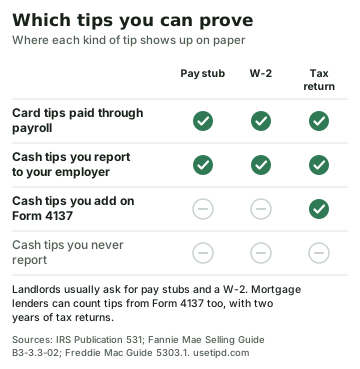
- Card tips are usually recorded by the restaurant's system and paid through payroll, so they're on your pay stubs and your W-2.
- Cash tips you report to your employer are added to your wages too. The IRS says tips you reported are included in the wages in box 1 of your W-2, and from the 2026 W-2 on they also show in box 12 with code TP. Allocated tips in box 8 aren't part of your wages; they go on your return through Form 4137.
- Cash tips you report only on your tax return, through Form 4137, are on your return but not on your pay stubs or W-2.
- Cash tips you never report aren't on any paper from your employer or the IRS. Lenders can't count them, and a landlord can see them only if you show them some other way, like bank deposits.
Some landlords and lenders also check your income through a service like Equifax's The Work Number, which gets pay records straight from employers and payroll companies. A tip that never went through payroll can't show up there either.
those cash tips you didn’t report don’t exist in our world either so the waiter making 60 but claiming 40 only makes 40
The papers that prove tip income
The papers landlords and lenders ask for:
- Pay stubs. Your most recent ones, with the year-to-date totals. They show your current income, which is what a landlord cares about most.
- W-2s. The last one or two years. Reported tips are part of the wages in box 1.
- Tax returns, or the IRS's transcripts of them. A tax return transcript shows most lines of your return as you filed it, and a wage and income transcript shows what your employers reported, generally from the first week of February for the year before. You can get both from your IRS online account. Mortgage lenders often get them straight from the IRS, with your permission, through Form 4506-C.
- A letter from your employer, or a verification of employment: your job, your start date, your hourly wage, and your hours and tips from payroll.
- Bank statements, which show your pay and any cash you deposit.
- Your own tip record. Since it comes from you, treat it as backup. It explains your deposits, covers the months your stubs don't, and lets you catch a mistake on a W-2 before it costs you.
Renting an apartment
Landlords generally want your income to be two to three times the monthly rent, according to Zillow, and Apartments.com tells landlords most ask for at least three. Both name pay stubs from the last two or three months, your latest W-2 and a letter from your employer; tax returns and two or three months of bank statements come up too, mostly for self-employed renters. Apartments.com also warns landlords that a W-2 or tax return may not show what you make now, so expect pay stubs either way.
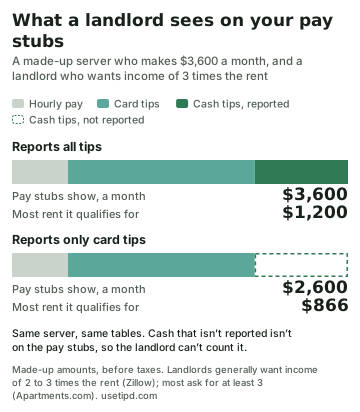
That's where unreported cash hurts. Take a server who makes $3,600 a month: $600 in hourly pay, $2,000 in card tips and $1,000 in cash.
Start claiming all your tips. I’d want to see proof of income in the form of check stubs - usually a month’s worth.
To make your case:
- Bring three months of pay stubs, not two, so a slow week doesn't set your number.
- Add your bank statements if you deposit your cash tips, so the deposits back up what your stubs say.
- Ask your manager for a letter with your job, your start date, your hourly wage and your average hours and tips from payroll.
- Add up the gross pay on your stubs, your pay before taxes, before you go, so you know roughly what rent your income supports.
A car loan
A car loan application asks for your total gross monthly income, your income before taxes, and how long you've worked where you work, according to the Consumer Financial Protection Bureau's guide to auto loans. Lenders then ask for proof of income, such as pay stubs, W-2s, tax returns or bank statements, according to Bankrate's checklist. The same rule applies: the tips they can count are the tips on those papers, so bring your pay stubs and last year's W-2 to the dealer.
A mortgage: two years of tips, averaged
Mortgages are the strictest. Many lenders follow the rules of Fannie Mae and Freddie Mac, which buy home loans from lenders, or of the FHA, which insures home loans. All three treat tips like overtime or bonuses: income that changes from month to month, so they want a history of it and they average it.
- Fannie Mae asks for your most recent pay stub and two years of W-2s (or a verification form your employer fills in), plus a last check with your employer, or a verification service, that you still work there. It recommends a two-year history of tips and may accept as little as 12 months if the rest of your application is strong. For tips your employer didn't report, two years of tax returns with Form 4137 can take the place of the W-2s.
- Freddie Mac wants two consecutive years of tips, or at least one year in some cases, that are likely to continue for at least three more. Employer-reported tips need your year-to-date pay stubs and two years of W-2s, or a written verification from your employer. Tips reported on Form 4137 need Form 4137 and your complete tax returns for the last two years. Freddie Mac's guide even uses a server earning tips as one of its examples.
- The FHA counts tips you've received for the past two years, or at least one year if you've earned them consistently, and only income that was properly reported on your tax returns when it had to be.
Then they average. Fannie Mae adds this year's tips so far to last year's and divides by the months. Say your 2025 W-2 shows $30,000 in tips and your pay stubs through June 2026 show $16,800 so far: that's $46,800 over 18 months, or $2,600 a month in tip income, on top of your hourly wage. The FHA uses whichever is lower, your two-year average or your last year's.
A bad year counts against you. If your tips are falling, Fannie Mae wants to see that they've leveled off before it counts them at all, and then it uses only the lower recent amount. Freddie Mac also uses only your current, lower income, and for a drop of more than 10% the lender must find out why and show your income has leveled off. If something outside your control stopped your tips for a while, like your restaurant closing for renovations, Fannie Mae and Freddie Mac can leave that period out, as long as it's documented and at least 12 months of income remain.
Your bank account gets checked too. When you buy a home and the lender uses your bank statements, Fannie Mae calls any single deposit of more than half your monthly qualifying income a large deposit. If you need that money for the down payment, closing costs or reserves, the lender has to document where it came from, and whatever it can't document is left out of your funds. A year of cash tips saved at home and deposited the month before you apply is exactly that: you'll have to explain it in writing, which is far easier when the tips are already on your W-2 or tax returns. Deposit your tips as you go.
Tips you didn't report: can you fix it?
For past years, you can file an amended return that adds the tips through Form 4137. You'll owe income tax and the 7.65% Social Security and Medicare tax on them, plus interest, and the IRS can add a penalty of 50% of that Social Security and Medicare tax unless you had a reasonable cause. And the IRS tax return transcript, the one that usually meets lenders' needs, shows your return as you first filed it, not later changes. So before you amend a return to qualify for a loan, talk to a tax preparer and ask your loan officer how they'd treat it.
You’d need to start reporting cash tips for the next couple of years. I’m a loan officer and we have to go based on your taxable income for conventional, fha, usda, and VA loans.
The cleaner fix is the one that starts now. Every month you report your tips to your employer is a month that counts, and two years from now you'll have the two-year history most mortgage lenders look for. Here's how to report your cash tips, with this year's deadlines.
No Tax on Tips gives you another reason to report
From 2025 through 2028, if you work in a job on the IRS's list of tipped occupations, as servers and bartenders do, you may be able to deduct up to $25,000 a year of tips reported on your W-2, a 1099 or Form 4137, with limits at higher incomes and other rules. That's No Tax on Tips, and it means reporting your tips can cost you less in income tax than it used to.
The deduction lowers the tax you owe, not the income lenders count. It's taken on your tax return, on Schedule 1-A, and the wages and tips on your W-2 stay the same. Reported tips also count toward your Social Security record, which sets your retirement and disability benefits.
Build your proof, starting with your next shift
- Report every shift's tips to your employer, by the 10th of the next month at the latest.
- Keep every pay stub, or a photo of each one, in one place.
- Deposit your cash tips every week or two, not in one big pile.
- Keep a daily tip record: the date, your cash and card tips, and what you tipped out.
- Check your W-2 each January against your own record, and ask your employer about any difference.
- File your tax return every year with all your tips, and keep a copy.
- Before you apply, gather three months of pay stubs, two years of W-2s and tax returns, two or three months of bank statements and a letter from your employer.
Where Tip’d fits
Tip’d is a tip tracker for iPhone. It isn't proof of income by itself, and a mortgage lender won't take an app's numbers in place of your pay stubs and W-2s. Some landlords will accept a tip record, though:
I used the tip tracking app for every shift for 2 years, and my landlord accepted that when I showed it along with cash for the deposit/first month.
Either way, the record makes your papers easy:
- Your daily tip record. Every shift you log keeps your cash tips, card tips and tip-outs apart, so you know what to report each month.
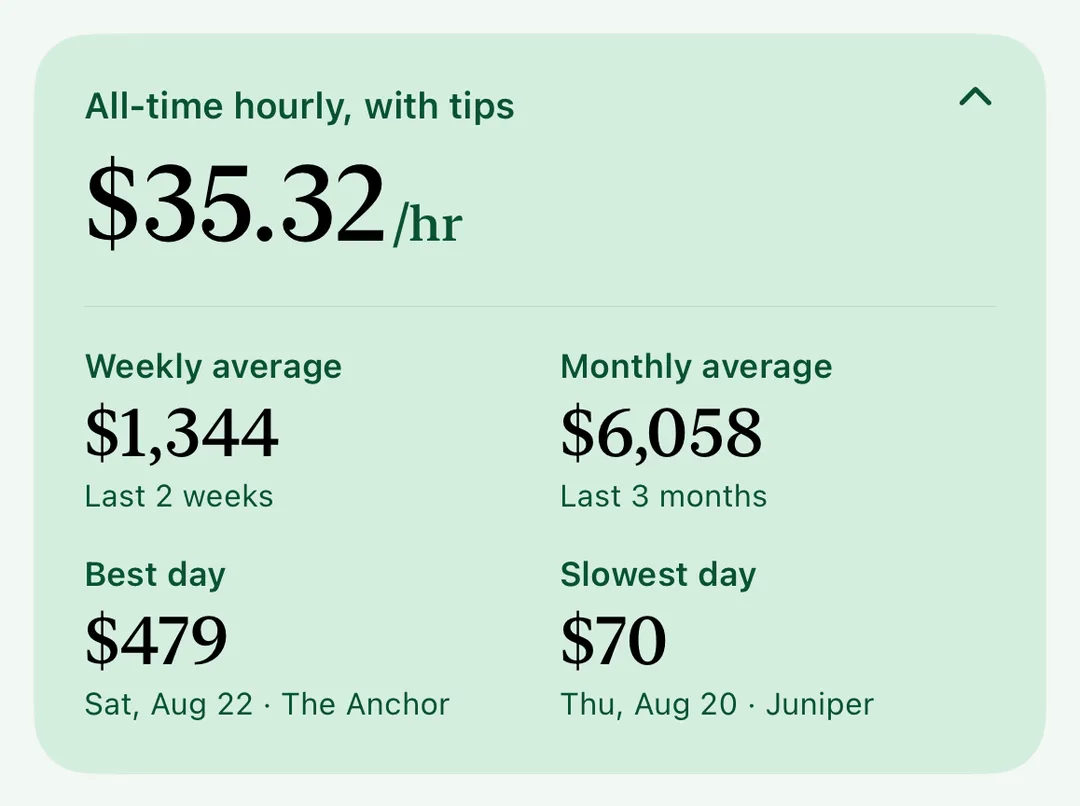
- What you make a month. Tap the card at the top of Stats to see your monthly average: your tips after tip-outs plus your hourly pay, before taxes. Compare it with the gross pay on your pay stubs. The difference is what isn't on your pay stubs yet.
- Your paychecks. Log each paycheck's net pay with a photo of its stub, so you can see every stub in one place and spot a missing one. Keep the originals to hand over.
- Your year on paper. The year screen exports a summary PDF and a spreadsheet of every shift, to check against your W-2.
Logging shifts is free, and they stay in your own iCloud.
Questions people ask
Do cash tips count as income for an apartment?
Only if you can show them. Cash tips you report to your employer are on your pay stubs and W-2, which is what landlords ask for. Bank statements showing regular deposits can help, but cash that's on no paper at all usually can't be counted.
Can I get a mortgage if I don't report my tips?
Tips you never reported anywhere can't be counted. Tips you didn't report to your employer but did put on your tax returns through Form 4137 can count with Fannie Mae and Freddie Mac, with two years of returns.
How many years of tips do I need for a mortgage?
Usually two. Fannie Mae may accept as little as 12 months if the rest of your application is strong, and Freddie Mac and the FHA can accept at least one year in some cases.
Does No Tax on Tips lower my income for a mortgage?
No. The deduction lowers the tax on your return. Your W-2 wages and tips, the income lenders count, stay the same.
Can I use a tip tracker app as proof of income?
Not for a mortgage: lenders want papers from your employer, the IRS or your bank. Some landlords will accept a tip record, but don't count on it. Your own record backs up your papers and helps you spot a mistake before someone else does.
Sources
- Fannie Mae Selling Guide B3-3.3-02: Bonus, Commission, Overtime, and Tip Income
- Fannie Mae Selling Guide B3-4.2-02: Depository Accounts (large deposits)
- Freddie Mac Single-Family Seller/Servicer Guide 5303.1: Employed income (tip income)
- HUD Handbook 4000.1, FHA Single Family Housing Policy (overtime, bonus or tip income)
- IRS Publication 531: Reporting Tip Income
- IRS: Transcript types for individuals and ways to order them
- IRS: Income Verification Express Service for taxpayers (Form 4506-C)
- IRS: Schedule 1-A, what to know about the new form
- IRS: Instructions for Form 1040-X (amended returns and interest)
- CFPB: Create a loan application packet
- CFPB: Consumer guide to auto loans
- Bankrate: Auto loan documentation checklist
- Zillow: How to show proof of income
- Apartments.com Rental Manager: Ways renters can show proof of income
- Equifax: The Work Number income and employment verification