
What a Democratic Senate Majority Means for Food Service Workers
By Joseph West · Published
Quick answer: Starting January 3, 2027, Democrats will hold 56 of the Senate’s 100 seats. That majority decides which bills get a vote, runs the committees and their hearings, and confirms or blocks the president’s nominees for the Labor Department and the labor board. It doesn’t let Democrats pass a wage law alone: under the Senate’s current rules most bills need 60 votes, four more than they have, and a bill becomes law only if President Trump signs it or two-thirds of both chambers override his veto. So the $2.13 federal tipped wage, the tip credit and no tax on tips all stay as they are for now. Democrats have floated bringing a minimum wage bill to the Senate floor; a new federal law would take at least four Republican senators and the president. Your state can move without either: several tipped wages rise on January 1 under laws already passed, and Pennsylvania’s governor says a minimum wage bill will be the first he signs.
Tip’d, our free tip tracker for iPhone and Android, shows what you really make an hour after tip-out, so you can see what any wage change would mean for your own shifts.
On this page
The last Senate race of 2026 was called on November 17: Democrats will hold 56 of the 100 seats when the new Congress starts on January 3, 2027, and Republicans 44. Democrats won the House too. If you serve, bartend, cook, host or wash dishes for a living, you’ve probably heard three things since: that your pay is about to go up, that your tips or hours are at risk, and that nothing will change.
None is quite right. This guide covers what a Senate majority can do by itself, what it can’t, what each party and the restaurant industry say they want, and where a food service worker’s pay is likeliest to move. Forecasts are labeled as forecasts and credited to whoever made them. Counts are as of November 18, 2026. For the tax side, see our earlier guide to no tax on tips after the 2026 election.
The Senate result, in numbers
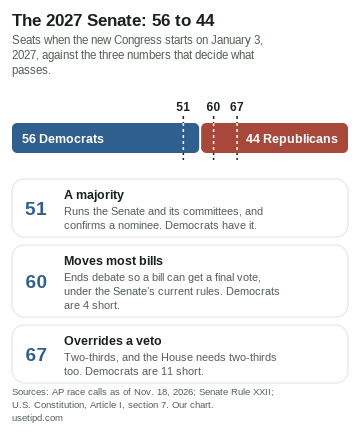
- 56 to 44. Democrats flipped nine Republican-held seats: Alaska, Iowa, Kansas, Maine, Mississippi, North Carolina, Ohio, South Carolina and Texas. The Associated Press called Mississippi for Scott Colom on November 11, and Alaska was called for Mary Peltola on November 17.
- 51 is a majority. It decides who runs the Senate, and it’s enough to confirm a nominee.
- 60 moves most bills. Ending debate on a bill takes 60 votes under the Senate’s current rules, so Democrats need at least four Republicans. A majority can change that rule, as the Senate did for nominees in the 2010s, though a bill would still need the president. “Four votes is easier than six,” Sen. Chuck Schumer, the Democrats’ leader, told The Washington Sun.
- 67 overrides a veto. A bill becomes law when the president signs it, or when two-thirds of both chambers vote to override his veto. Democrats are 11 senators short of that.
- The House: Democrats had won 257 of 435 seats by November 18, with seven races still open.
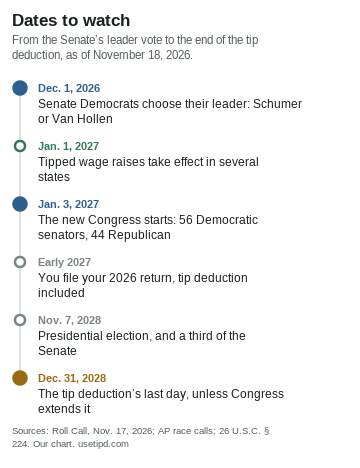
Leaders aren’t final yet. Senate Democrats vote on December 1, when Sen. Chris Van Hollen of Maryland is challenging Schumer for majority leader. Republicans re-elected Sen. John Thune of South Dakota as their leader on November 10. Until January 3, Republicans still run the Senate.
What a Senate majority can do by itself
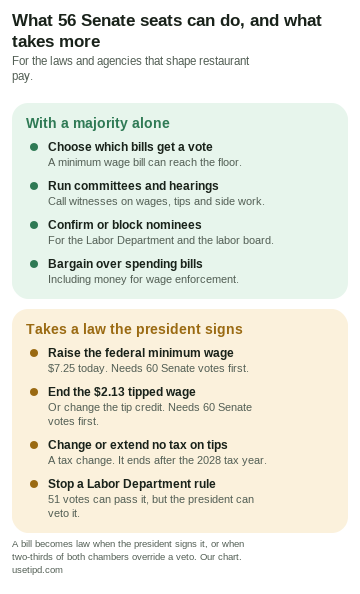
Decide what gets a vote
The majority leader sets the floor schedule. For the last two years, a minimum wage bill had no path to a Senate vote. Next year one can be called up, even if it then falls short of 60. The Washington Sun reported that Democrats plan to bring bills to the floor one at a time, among them a higher federal minimum wage, a return of the larger health insurance subsidies that expired after 2025 and a ban on stock trading by lawmakers.
Run the committees and their hearings
Committee chairs decide which bills get hearings and who gets called to testify. Sen. Bernie Sanders of Vermont, an independent who caucuses with Democrats, is expected to chair the committee that handles labor law, the Associated Press reported on November 18. His agenda, first given to the AP, would raise the federal minimum wage, which has been $7.25 since 2009, to $20 an hour over four years. It would also pass the PRO Act, a bill unions back that would make it easier to form a union, override state right-to-work laws, let the labor board certify a union from signed cards in some cases and narrow who can be treated as an independent contractor. The AP noted the wage increase could meet resistance from lawmakers who worry it would hurt small businesses and cost jobs.
Fisher Phillips, a law firm that represents employers, expects hearings, document requests and subpoenas aimed at the Labor Department and the labor board, and says hearings on wage enforcement “may name specific companies or industries.” A hearing doesn’t change your paycheck. It can put a practice such as tip theft on the record, and it can single out a company or an industry.
Confirm or block the president’s nominees
This is the power that needs no Republican votes and no signature. The officials who enforce your workplace rights need Senate confirmation: the secretary of labor, the head of the Wage and Hour Division (which enforces minimum wage, overtime and tip rules) and the members of the National Labor Relations Board (which runs union elections and rules on charges that an employer punished workers for organizing). A simple majority confirms them.
The new majority can’t remove people already confirmed to those jobs. What changes is that from January, any new nominee from President Trump needs Democratic votes. Fisher Phillips, the employer-side firm, says nominees for the labor board, the Equal Employment Opportunity Commission and senior Labor Department posts “will face a much harder path,” and that empty seats could slow those agencies’ plans.
Bargain over spending bills
Congress has to pass spending bills to keep the government open, and both chambers have to agree on them. That gives the majority a say over agency budgets, including how many investigators the Wage and Hour Division has to chase unpaid wages. Spending bills need 60 votes too, so this is leverage in a negotiation, not control.
What a Senate majority can’t do by itself
Raise the federal minimum wage or end the $2.13 tipped wage
Under federal law a restaurant can pay you as little as $2.13 an hour and count your tips toward the $7.25 minimum; that’s the tip credit, and the $2.13 hasn’t changed since 1991. Democrats’ main wage bill, the Raise the Wage Act, would lift the minimum to $17 and phase the tipped wage up until it disappears. Its sponsors are expected to update the numbers when they file it again in January, according to a National Restaurant Association memo to its members.
That bill needs 60 Senate votes and then the president’s signature, or two-thirds of both chambers to override a veto. It also needs every Democrat, and that isn’t certain. When the Senate last voted on a $15 minimum wage, in March 2021, it was a motion to set aside the budget rules and add the raise to that year’s relief bill; seven Democrats and one independent voted no, and four of those eight have since left the Senate. Several of the new Democratic senators won in states President Trump carried. One of them, Scott Colom of Mississippi, said on NBC’s Meet the Press, “we’ve got to raise the minimum wage. It’s been much too long,” without naming a number or mentioning the tipped wage.
Use the 51-vote budget shortcut for wages
One kind of bill, called budget reconciliation, can pass the Senate with a simple majority. It’s limited to taxes and spending. In February 2021 the Senate’s parliamentarian ruled that a minimum wage increase didn’t qualify, and it was taken out of that year’s relief bill. The Fiscal Times reported on November 13 that Democrats may turn to reconciliation if their one-at-a-time bills are blocked. Whether a new wage provision would fare differently would be up to the parliamentarian, and a reconciliation bill still goes to the president.
Cancel a Labor Department rule
A 2021 Labor Department rule, known as “80/20,” limited how much side work an employer could pay at the tipped wage; a federal appeals court threw it out in 2024. In October 2026 the department withdrew three old guidance letters on side work, said time limits on side work no longer reflect its policy, and said it is preparing a proposed rule on tipped workers. Congress can vote to cancel a new agency rule with simple majorities in both chambers, with no filibuster, under a law called the Congressional Review Act. But that vote goes to the president like any bill, and a president rarely signs away his own agency’s rule. So a Democratic Senate can question the rule in hearings and slow the people who write it; stopping it would take the president or the courts.
Change this year’s taxes
The No Tax on Tips deduction and the overtime deduction, part of the tax law Republicans passed in 2025, are law for the 2025 through 2028 tax years. Nothing about the Senate changes your 2026 return. Neither deduction touches Social Security and Medicare tax, which still apply to the tips you report.
What each side says it wants
Democrats and unions
The week after the election, the leaders of the Congressional Labor Caucus and AFL-CIO President Liz Shuler laid out what they called a “Pro-Worker Path Forward”: the PRO Act first, along with a higher federal minimum wage (no figure given), paid leave, child care, the larger health insurance subsidies that expired after 2025, and protections for worker data and for whistleblowers who raise concerns about artificial intelligence. Their argument is that people are “working more, earning less” as prices rise: the $7.25 minimum hasn’t changed since 2009, and the $2.13 tipped wage hasn’t since 1991. Fisher Phillips says they see the election as a mandate for organized labor. Sanders’s $20 goes further than the $17 bill most Democrats have signed on to, so Democrats don’t yet agree among themselves on a number.
Republicans
In a Senate floor speech the day before Republicans re-elected him as leader, Thune called the election a “tough night” and said that “the American people are not looking for socialist government and leftist fantasies,” the AP reported; it also reported that he said Republicans would be willing to work with Democrats. Republicans’ main measure for tipped workers is the no tax on tips deduction they wrote into the 2025 tax law; it ends after 2028 unless Congress extends it. Republicans have generally opposed ending the tip credit; the restaurant association’s memo calls it an open question whether the party’s populist wing will join Democrats on a wage bill. Their case is that ending the credit could cost servers tips: in 2019, President Trump’s White House said it “could discourage tipping.” (Federal law already makes an employer make up the difference when a tipped worker’s wage plus tips falls short of $7.25 an hour.) One prominent Republican backs a raise: Sen. Josh Hawley of Missouri has a $15 minimum wage bill with Democratic Sen. Peter Welch that keeps the $2.13 tipped wage and the tip credit. President Trump said before the election, “I guess I’ll become Mr. Veto,” and that after “a month or two” of vetoes, “you make a deal.”
The restaurant industry
The National Restaurant Association’s post-election memo to members says, “Protecting the tip credit will remain a top priority.” Its argument is that ending the credit would lower tipped workers’ take-home pay; in 2023 it called ending it a “non-starter.” Restaurant owners also argue that it would push restaurants toward service charges, which aren’t tips. Mike Whatley of the association told Restaurant Dive, “You’re going to see action on minimum wage, potentially on tip credit, other labor issues at the federal level.” The same memo says immigration “could be one of the real opportunities of the new Congress,” saying restaurants are short of workers, and says the association will press for lower costs from card swipe fees and tariffs.
Groups that want the tipped wage ended
One Fair Wage, which campaigns to end the tipped wage, argues that a $2.13 base leaves servers’ pay at customers’ discretion, which it says leads workers to put up with harassment, and that the seven states that already require the full minimum wage before tips have thriving restaurants and higher tips. Voters have gone both ways: in 2024 Massachusetts rejected ending the tipped wage, 64% to 36%, and Arizona rejected a measure that would have let employers pay tipped workers less, by about three to one. Since then the D.C. Council has scaled back the phase-out voters approved in 2022, so the tipped wage now rises to 75% of the minimum by 2034 instead of the full minimum, and Chicago has paused its phase-out for two years.
What might pass with votes from both parties
These are possibilities, not predictions. Each needs at least four Republican senators and the president.
- A minimum wage deal. A bipartisan $15 bill from Sens. Hawley and Welch exists, and most Democrats want more. A compromise is possible, and the open question for tipped workers is whether it would touch the $2.13. Fisher Phillips, the employer-side law firm, called a federal $17 minimum “unlikely to become law any time before 2029, if at all” just after the election. A week later it wrote that the PRO Act, a federal minimum wage increase and a national paid leave law were once unthinkable, “but all bets are now off.”
- Faster first union contracts. The Faster Labor Contracts Act, from Republican Sen. Hawley and Democratic Sen. Cory Booker, would set deadlines for bargaining after workers vote to unionize. Fisher Phillips says it “stands a good chance of reaching a floor vote next year.”
- Keeping no tax on tips past 2028. Members of both parties have filed bills to make it permanent; our earlier guide lists them. No leader in either party has proposed a deal since the election.
- Immigration and swipe fees. The restaurant association’s memo says President Trump named immigration as an area where he could work with Democrats, and that Sen. Welch plans to lead the swipe fee issue in the Senate. Both are mainly about restaurants’ costs and staffing, not your hourly wage.
On health coverage, Democrats in both chambers say they’ll move first to bring back the larger Affordable Care Act subsidies, a temporary expansion that ended after 2025, and to reverse the 2025 law’s reductions in Medicaid and food-aid spending. If you buy your own insurance or use either program, that fight may matter to you more than the wage bill. KFF Health News noted that President Trump could veto those bills.
Where change doesn’t need Congress: your state
Your wage before tips is set mostly by your state, and states don’t need 60 Senate votes or the president.
- January 1 raises. Several states raise their tipped wage on January 1, 2027, under laws already passed. See the list in tipped minimum wage 2027.
- New Democratic governments. Democrats won the governor’s office and both chambers in Arizona, Michigan, Minnesota, Nevada, Pennsylvania and Wisconsin. The restaurant association, which lobbies to keep the tip credit, tells its members to expect tip credit fights in Michigan, Pennsylvania and Wisconsin in 2027, and paid leave and scheduling bills in Minnesota, Nevada and Wisconsin.
- Pennsylvania. Gov. Josh Shapiro says a minimum wage bill will be the “very first bill” he signs. A bill the state House passed in March 2026 would set the tipped wage at 60% of the regular minimum; today’s tipped cash wage is $2.83.
To see where your state stands now, check server pay by state or the tipped minimum wage calculator.
The dates to watch
What to do now
- Know your real hourly pay. Wage plus tips, minus tip-out, divided by hours. It’s the number that tells you whether a higher base wage, a service charge or a new tip pool would leave you ahead or behind. Our real hourly pay calculator does the math.
- Keep a daily tip record. The tip deduction depends on it, and it’s your proof if a paycheck or a W-2 is wrong.
- Check your state’s January 1 wage. If your tipped wage goes up, your first January paycheck should show it.
- Know the rules that already protect you. Managers can’t take a share of your tips, and if your tips don’t bring you to the minimum wage, your employer makes up the difference. See can your employer take your tips.
- Watch for the Labor Department’s tipped-worker rule. Once it’s proposed, anyone can send the department a comment, for or against.
A tip tracker app makes the first two painless. Tip’d, our free app for iPhone and Android, logs each shift’s cash tips, card tips, tip-out and hours in a few taps and shows your real hourly pay by shift, week and job. Whatever Congress or your state decides, you’ll know what it means for your own numbers.
Questions people ask
Will the minimum wage go up now that Democrats control the Senate?
Not automatically. A federal increase needs 60 Senate votes, and Democrats will have 56. It then needs the president’s signature or a two-thirds vote to override a veto. A higher minimum wage is among the bills Democrats have floated bringing to the floor one at a time, The Washington Sun reported; a new law needs at least four Republican senators and the president. Many states raise their own minimums on January 1.
Will the $2.13 tipped minimum wage end?
Not unless Congress passes a law the president signs, or overrides his veto. Democrats’ main bill would phase it out, with unions and One Fair Wage for it and the restaurant industry against it; it has no Republican co-sponsors, and it faces the same 60-vote rule. Seven states already require the full minimum wage before tips; Massachusetts voters kept their tipped wage in 2024.
If the tipped wage ended where you work, any tips customers leave would still be yours by law. Whether they’d tip as much is disputed: One Fair Wage says tips are higher in the seven states that pay the full wage, and the restaurant industry says some restaurants would switch to service charges, which aren’t tips.
Can the Senate get rid of the tip credit without Republicans?
Not under the Senate’s current rules. Ending the tip credit means changing federal wage law, which takes 60 votes, and then the president’s signature or two-thirds of both chambers. The 51-vote budget shortcut is limited to taxes and spending, and in 2021 the Senate’s parliamentarian ruled that a minimum wage increase didn’t qualify.
Does a Democratic Senate change no tax on tips?
No. The deduction is law through the 2028 tax year. Changing or extending it takes a new law the president signs, or two-thirds of both chambers. Members of both parties have bills to make it permanent.
What can the Senate do without the president?
Hold hearings, investigate, and confirm or reject his nominees. It can also decline to bring up bills it opposes. It can’t make a law without him unless two-thirds of both chambers override a veto.
Who will run the Senate’s labor committee?
Sen. Bernie Sanders is expected to chair the Committee on Health, Education, Labor and Pensions, the Associated Press reported. Committee assignments become official after the new Congress starts on January 3, 2027.
Does this affect cooks and dishwashers, or only tipped workers?
Both. A federal minimum wage increase would reach untipped kitchen jobs in states that use the federal $7.25. Overtime rules, scheduling laws, paid leave and health coverage apply to the whole staff. The tip credit and tip rules matter most to the front of the house.
Is this political advice?
No. It’s a plain-language summary of rules, bills and public statements as of November 18, 2026, with forecasts labeled and credited. We make a tip-tracking app; we don’t endorse a party or a candidate.
Sources
- The result: Yahoo News, final 2026 midterm results, WLOX on the AP’s Mississippi call, Roll Call on the December 1 leader vote and AP on Sen. Thune’s re-election as Republican leader
- The Senate’s rules: the Senate on filibusters and cloture, nominations and vetoes; the Congressional Research Service on the Congressional Review Act; and CNN on the 2021 parliamentarian ruling
- The 2021 vote: the Congressional Record, March 5, 2021
- Wage law and tip rules: the Labor Department’s tipped wage table and Field Assistance Bulletin 2026-1, the Raise the Wage Act of 2025, Sens. Hawley and Welch’s $15 bill (its text) and Sens. Booker and Hawley’s Faster Labor Contracts Act
- What each side says: AP on Sen. Sanders’s plans, the Congressional Labor Caucus’s “Pro-Worker Path Forward”, The Washington Sun on Sen. Schumer’s plans, The Fiscal Times on reconciliation, Magnolia Tribune on Sen.-elect Colom’s Meet the Press interview, Newsweek on “Mr. Veto”, the White House’s 2019 statement on the Raise the Wage Act, the National Restaurant Association’s post-election memo, as posted by Hospitality Indiana, the association’s 2023 statement on the Raise the Wage Act, Restaurant Dive, November 10, 2026, One Fair Wage and KFF Health News
- Forecasts: Fisher Phillips on the Labor Caucus agenda and on the election
- States: NCSL on the state results, The Philadelphia Inquirer on Pennsylvania, the Mon Valley Independent on Pennsylvania’s House bill and Ballotpedia on Massachusetts Question 5 and Arizona Proposition 138, The 51st on D.C. and Block Club Chicago