
No Tax on Tips and the 2026 Blue Wave: What Democrats Could Change
Published
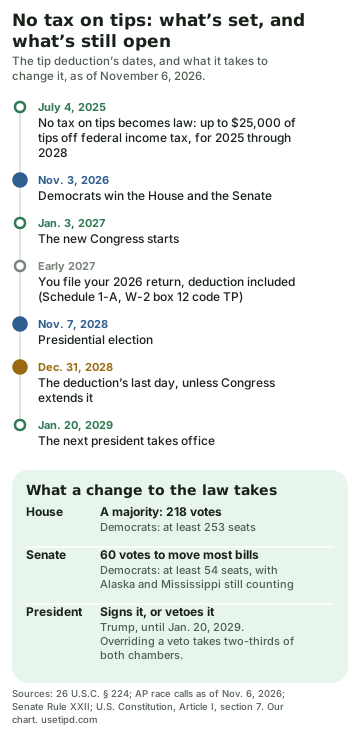
Quick answer: For now, no tax on tips stays: it’s federal law through the 2028 tax year, so it doesn’t change on your 2026 return, and changing it takes a law the president signs or two-thirds of both chambers. Every Democrat voted against the 2025 law that created the tip break, and many say they objected to its other parts. Bills some Democrats have filed would keep the break and widen it (count automatic gratuities, double the cap for married couples, drop the end date). Their main wage bill, which has no Republican co-sponsors and which the restaurant industry opposes, would raise and then end the $2.13 tipped minimum wage. Democratic leaders haven’t said what they’ll do about tips since the election. The real deadline is December 31, 2028, when the deduction ends unless Congress extends it.
Tip’d, our free iPhone tip tracker, keeps the daily tip record the deduction depends on and counts your tips against the $25,000 limit on its Year screen.
On November 3, 2026, Democrats won control of both the House and the Senate. CNN called it “a historic blue wave,” and Fox News wrote that Democrats were “riding a blue wave.” If you work for tips, two questions follow: does “no tax on tips” survive, and could the $2.13 tipped wage go up?
Here’s what’s settled, what Democrats have pushed for when they’ve had the chance, what Republicans and the restaurant industry say, and what could realistically happen in 2027 and 2028. Nobody knows the future, so every forecast below is labeled as one and tied to a bill, a vote or a named source. Counts are as of November 6, 2026, and some races are still being counted.
What happened in the 2026 election
- The House: The Associated Press called it for Democrats early on November 4. By early November 6, AP had called 253 seats for Democrats and 157 for Republicans, with 25 races still open; 218 is a majority.
- The Senate: Democrats hold at least 54 of 100 seats after flipping seven held by Republicans: North Carolina, South Carolina, Ohio, Texas, Kansas, Iowa and Maine. Alaska and Mississippi are still counting.
- Governors: Democrats flipped Georgia, Iowa, Nevada, Ohio and Texas and hold at least 28 governorships. They now control the governor’s office and both chambers in Arizona, Michigan, Minnesota, Nevada, Pennsylvania and Wisconsin.
- Not a veto-proof majority: overriding a veto takes two-thirds of both chambers, 290 House votes and 67 senators, and Democrats are well short of both.
The new Congress starts on January 3, 2027. President Trump’s term runs to January 20, 2029, and every bill Congress passes still goes to him to sign or veto.
Does the blue wave change your 2026 taxes?
No. The No Tax on Tips deduction is written into the tax code for the 2025, 2026, 2027 and 2028 tax years. On the 2026 return you file in early 2027, you can still deduct up to $25,000 of qualified tips, and your W-2 will show the tips you reported in box 12 with code TP. Social Security and Medicare tax still apply to the tips you report, as before.
No statewide ballot measure on November 3 was about tips or tipped wages, either. Whether your state taxes your tips depends on its own law, which we track in no tax on tips by state.
Where Democrats stand on no tax on tips and the tipped wage
Democrats haven’t spoken with one voice on tips, but their bills and votes point the same few ways.
No tax on tips: many Democrats back it, some want it bigger and permanent
Donald Trump pledged it at a Las Vegas rally in June 2024, and two months later Kamala Harris endorsed ending taxes on tips in the same city, paired with raising the minimum wage. Nevada’s two Democratic senators, Jacky Rosen and Catherine Cortez Masto, co-sponsored Sen. Ted Cruz’s No Tax on Tips Act in January 2025, and in May Rosen brought it to the floor, where it passed by unanimous consent, with no senator objecting. Seven House Democrats co-sponsored the House version.
But no Democrat voted for the law that created the deduction, the One Big Beautiful Bill Act, which the IRS now calls the Working Families Tax Cuts. It passed the House 218 to 214 and the Senate 51 to 50, and there was never a separate vote on tips. Democrats said they voted no mainly over the bill’s Medicaid and food-aid cuts and tax cuts they called skewed to the wealthy, according to FactCheck.org. President Trump says every Democrat “voted against no tax on tips.” Both describe the same vote: Democrats opposed the whole bill, and the tip break was one part of it, along with making the 2017 tax cuts permanent.
Democratic versions of the idea come from Rep. Steven Horsford of Nevada. His TIPS Act (H.R. 1314), with 32 Democratic co-sponsors, would end the $2.13 wage and let workers deduct all their reported tips with no dollar cap, but only if their income is $112,500 or less. His newer TIP Improvement Act of 2026 (H.R. 7577), which has one co-sponsor, would:
- make the deduction permanent instead of ending after 2028,
- double the $25,000 cap for married couples filing together,
- count automatic gratuities, such as large-party charges a customer can’t change or skip, in restaurants, hotels and salons, which don’t qualify today, and
- require tipped workers to be paid the full minimum wage before tips.
Sen. Ruben Gallego of Arizona has a bill (S. 2780) to count large-party gratuities, and in August 2025 Nevada’s Democrats asked the Treasury to count auto-gratuities and suggested tips. Not everyone on the left praises the tip break, though. In 2025, a spokeswoman for the party’s House campaign arm faulted Republicans for giving working families only small, temporary breaks while making what she called tax cuts for billionaires permanent, and the left-leaning Center on Budget and Policy Priorities, a think tank, wants the deduction repealed or left to expire.
Democrats and the $2.13 tipped minimum wage: raise it or end it
Under federal law, a restaurant can pay you as little as $2.13 an hour in cash wages and count up to $5.12 of your tips toward the $7.25 minimum wage. That’s called the tip credit, and if your tips fall short, the restaurant must make up the difference. That $2.13 hasn’t changed since April 1991. For the raises already scheduled in the states, see tipped minimum wage 2027.
The main Democratic bill is the Raise the Wage Act of 2025 (H.R. 2743 in the House, from Rep. Bobby Scott, and S. 1332 in the Senate, from Sen. Bernie Sanders, an independent who caucuses with Democrats). It would raise the minimum wage to $17 an hour five years after it takes effect, raise the tipped cash wage from $6.00 when it takes effect to $17.00 six years later, and then end the separate tipped wage, with workers keeping all their tips. Its sponsors say phasing out the tipped wage “will ensure decent, consistent pay without eliminating tips.” The bill has 177 Democratic co-sponsors in the House and 34 in the Senate, and no Republicans. A newer bill, the Living Wage for All Act (H.R. 8555), would go to $25 an hour and also end the tipped wage. The Congressional Budget Office estimated in 2021 that a $15 federal minimum would lift 900,000 people out of poverty and cost about 1.4 million jobs.
Democrats have tried before. In July 2019 a Democratic House passed a $15 version 231 to 199, and the Republican Senate never took it up. In March 2021, with Democrats running the Senate, a $15 amendment to the COVID relief bill failed 42 to 58 on a procedural vote, with seven Democrats and one independent voting no. The last raise was passed in 2007, when a Democratic Congress and Republican President George W. Bush agreed to lift the minimum in steps to $7.25 by 2009; the $2.13 tipped wage stayed the same.
Most Republicans in Congress and the restaurant industry push the other way. Sen. Josh Hawley, a Republican, has a $15 minimum wage bill with Democratic Sen. Peter Welch, but it would leave the $2.13 tipped wage alone. In 2019, President Trump’s White House said ending the tip credit “could discourage tipping.” The National Restaurant Association called ending it a “non-starter” in 2023, saying it would lower tipped workers’ take-home pay. In October, Restaurant Dive reported that the association plans to keep defending the tip credit, though the association’s list of priorities for the new Congress, released after the election, left it out. House Republicans’ Tipped Employee Protection Act (H.R. 2312), which the association supports, would let restaurants pay the tipped wage for any of a tipped worker’s duties, as long as tips bring pay up to the minimum wage; its sponsor, Rep. Steve Womack, says it aims to “end regulatory confusion.” It cleared committee in November 2025 and reached the House floor in January 2026, where the final vote was put off.
Tip theft and side-work rules
Since a 2018 spending law signed by President Trump, federal law has barred employers and managers from keeping workers’ tips and lets the Labor Department fine employers who do; a 2021 rule under President Biden let those fines apply to any violation, not only repeated or willful ones. Biden’s Labor Department also issued a 2021 “80/20” rule that limited how much side work an employer could pay at the tipped wage. A federal appeals court threw it out in 2024, and in October 2026 the Labor Department under President Trump withdrew three old guidance letters on side work, said time limits on side work no longer reflect its policy, and said it is preparing a proposed rule on tipped workers.
Some Democratic-led places have pulled back
Ending the tipped wage has been a hard sell even where Democrats run things. Massachusetts voters rejected it in 2024, 64% to 36%. Washington, D.C.’s council scaled back its voter-approved Initiative 82 in July 2025, holding the tipped wage at $10 until July 2026 and capping its climb at 75% of the minimum wage by 2034. Chicago’s council paused its phase-out in May 2026. In Michigan, Democratic Gov. Gretchen Whitmer signed a 2025 law, passed mostly with Republican votes, that keeps a tip credit, with the tipped wage reaching half the minimum wage by 2031. Opponents, restaurant owners among them, argue that ending the tip credit pushes restaurants toward service charges, and under the IRS’s rules a mandatory service charge doesn’t count for the tip deduction. Seven states, including California, Minnesota and Nevada, already require the full minimum wage before tips.
The tip bills on file in Congress
| Bill | From | What it would do | Where it stands |
|---|---|---|---|
| No Tax on Tips Act (S. 129) | Sen. Cruz (R), with Sens. Rosen and Cortez Masto (D) | A $25,000 tip deduction with no end date | Passed the Senate in May 2025; waiting in the House |
| No Tax on Tips Act (H.R. 482) | Rep. Buchanan (R), with seven Democrats among its co-sponsors | The same, in the House | In committee |
| TIPS Act (H.R. 1314) | Rep. Horsford (D), with 32 Democratic co-sponsors | Ends the tipped wage; a tip deduction with no dollar cap for incomes up to $112,500 | In committee |
| TIP Improvement Act of 2026 (H.R. 7577) | Rep. Horsford (D) | Makes the deduction permanent, doubles it for couples, counts automatic gratuities, and requires the full minimum wage before tips | In committee |
| No Tax on Large Party Tips Act (S. 2780) | Sen. Gallego (D) | Counts large-party gratuities and suggested tips as tips | In committee |
| Raise the Wage Act of 2025 (H.R. 2743, S. 1332) | Rep. Scott (D) and Sen. Sanders (I), with only Democratic co-sponsors | $17 minimum wage; the tipped wage rises to match it, then ends | In committee |
| Living Wage for All Act (H.R. 8555) | Rep. Ramirez (D) | $25 minimum wage, no tipped wage | In committee |
| Tipped Employee Protection Act (H.R. 2312) | Rep. Womack (R) | Lets restaurants pay the tipped wage for all of a tipped worker’s duties, side work included | Reached the House floor in January 2026; final vote put off |
Any bill that isn’t law when this Congress ends on January 3, 2027 dies, even S. 129, which passed only the Senate, so expect new versions with new bill numbers next year.
What a Democratic Congress could do about tips in 2027 and 2028
These are possibilities, not predictions. Each depends on votes Democrats don’t control alone: most Senate bills need 60 votes to move, Democrats have at least 54, and President Trump can veto anything. He said before the election, “I guess I’ll become Mr. Veto,” and that after “a month or two” of vetoes, “you make a deal.”
What forecasters expect: many bills, few new laws
A Democratic House could pass a minimum wage bill, as it did in 2019. CNN reported, citing people close to Hakeem Jeffries, who is running for speaker, that he wants to raise the minimum wage “by much more than Democrats tried to in 2019.” His own post-election letter to colleagues didn’t mention the minimum wage; it listed Medicaid, food aid, health insurance credits, tariffs and the Iran war. Getting a wage bill through the Senate and past a veto is another matter. Fisher Phillips, a law firm that represents employers, calls a federal $17 minimum “unlikely to become law any time before 2029, if at all.” Philip Wallach of the American Enterprise Institute, a conservative think tank, expects Democrats to push plenty of bills that have no realistic chance of becoming law because of the president’s veto, and said they can at least use them to build their party’s brand for 2028, Cronkite News reported. He also said there “should be some areas where Congress can act whether president Trump likes it or not.”
Possible: a deal to keep no tax on tips
This is the one tip policy with backers in both parties. President Trump promised at an October rally, while asking voters to keep Republicans in charge of Congress, to “make all Trump tax cuts permanent, including no tax on tips,” and some Democrats want it permanent and wider. A deal could extend it past 2028, perhaps with Democratic changes such as counting auto-gratuities, but no leader in either party has proposed one since the election.
Each side has numbers to point to: the Treasury says more than 7.5 million filers claimed the deduction on their 2025 returns, with an average deduction over $7,000, and the Tax Policy Center estimates that about 3% of taxpayers benefit. What stands in the way is cost and priorities. A permanent tip deduction would cost about $83 billion over 2025 to 2034, by a 2025 Congressional Budget Office estimate, compared with $32 billion for the version that ends after 2028, the Bipartisan Policy Center reports. The Tax Foundation puts extending all four of the law’s temporary deductions (tips, overtime, car-loan interest and the senior deduction) at $577.3 billion over ten years, and the federal deficit was nearly $2 trillion in the 2026 budget year, CNBC reported. The agendas Democratic leaders laid out after the election (reversing Medicaid cuts, extending health insurance credits, stopping tariffs, lowering grocery and gas prices) didn’t mention tips. The Tax Foundation’s read: “It’s unclear how Democrats would approach the expiring provisions.” The accounting firm Plante Moran expects current tax law “to remain largely untouched through 2028.”
Possible: pressure on the IRS and the Labor Department
The majority runs the committees, so Democrats can hold hearings and press agencies without passing anything. Fisher Phillips expects hearings, document requests and subpoenas aimed at the Labor Department. The department’s coming rule on tipped work could be one subject, but blocking that rule would take a new law, which the president can veto. Counting auto-gratuities would take a new law, too: the tax code says a tip must be voluntary, and the IRS’s final rules in April 2026 left out service charges customers can’t change or skip.
Where change doesn’t need Congress: the states
Your pay before tips is set mostly by your state, and the blue wave reached state capitals too.
- Pennsylvania now has a Democratic governor and legislature, and Gov. Josh Shapiro says a minimum wage bill will be the “very first bill” he signs. A bill the state House passed in March 2026 would set the tipped wage at 60% of the regular minimum; today’s tipped cash wage is $2.83.
- Wisconsin’s governor-elect, David Crowley, would sign a bill ending state income tax on tips and overtime if the legislature passed one, a campaign spokesperson told WPR in October, and Democrats now run both chambers. His Republican opponent, Tom Tiffany, had pledged the same, and in April Democratic Gov. Tony Evers vetoed a tips break passed by the Republican legislature because it would have ended in 2028.
- Minnesota and Nevada, two of the states where Democrats now control the governor’s office and both chambers, already require the full minimum wage before tips.
- Michigan: One Fair Wage, which campaigns to end the tipped wage, says it is aiming for 2028.
The date that matters: December 31, 2028
That’s the deduction’s last day. Unless Congress extends it, tips you earn in 2029 are back to being fully taxed. The new Congress and President Trump can extend it in 2027 or 2028; if they don’t, it falls to the Congress and president chosen on November 7, 2028, who take office after it has already ended. Plante Moran expects the “no tax” deductions to be “prominent focal points” of the 2028 campaigns.
What to do now
- Claim the deduction on your 2026 return. Check box 12, code TP, and the occupation code in box 14b on each W-2, then claim your qualified tips on Schedule 1-A.
- Report every tip. Only reported tips can be deducted, and tips of $20 or more in a month go to your employer by the 10th of the next month. Here’s how to report your tips.
- Keep a daily tip record. The IRS asks for one, and it’s your proof if your W-2 is ever wrong.
- Watch your state. State lawmakers can change tip taxes and tipped wages without Congress or the president.
A tip tracker app makes the record painless. Tip’d, our free iPhone app, logs each shift’s cash tips, card tips, tip-out and hours in a few taps and keeps each job apart. Its Year screen counts the tips you kept against the $25,000 limit, and its spreadsheet and PDF exports put the totals in front of your tax preparer. Whatever Congress decides about the deduction, a clean record of what you earned stays useful, for your taxes and for proving your income when you rent an apartment or take out a loan.
Questions people ask
Will no tax on tips end now that Democrats control Congress?
Not because of the election alone. The deduction is law through the 2028 tax year, and repealing it early would take a bill the president signs or a two-thirds vote to override his veto. Many Democrats say they support the deduction, and some want to make it bigger and permanent. The real question is whether anyone extends it past December 31, 2028.
Did Democrats vote against no tax on tips?
Every Democrat voted against the 2025 law that included it, and there was never a separate vote on tips. President Trump says that means they voted against no tax on tips; Democrats say they opposed the law’s Medicaid and food-aid cuts. Two Democratic senators co-sponsored the stand-alone No Tax on Tips Act, and one of them, Jacky Rosen, brought it to the floor, where it passed by unanimous consent in May 2025.
Do Democrats support no tax on tips?
Many do, but not all. Two Democratic senators co-sponsored the stand-alone No Tax on Tips Act, and House Democrats have filed bills to make the deduction permanent and wider. No Democrat voted for the 2025 law that created it, and some left-leaning groups want it to expire. Democratic leaders’ post-election agendas didn’t mention it.
Will the $2.13 tipped minimum wage go up under Democrats in 2027?
Probably not at the federal level. A Democratic bill to end the $2.13 would need 60 votes to move in the Senate, and the president could veto it. The employer-side law firm Fisher Phillips calls a federal $17 minimum “unlikely to become law any time before 2029, if at all.” Several states raise their tipped wage on January 1, 2027, and Pennsylvania’s new Democratic government says a minimum wage bill comes first.
Can Democrats get rid of the tip deduction?
Not without President Trump or a two-thirds vote of both chambers, and Democrats are well short of two-thirds. Trump campaigned on the deduction and signed it into law, and many Democrats say they want to keep it, not end it. If Congress does nothing, it ends on its own after 2028.
Does the election change my 2026 tax return?
No. You claim the deduction on Schedule 1-A for 2026, as planned. Changing the 2026 rules would take a new law, and President Trump, who backs the deduction, could veto one.
What happens to no tax on tips after 2028?
It ends after the 2028 tax year unless Congress extends it, which takes a new law. Both parties have members who want it permanent, and the accounting firm Plante Moran expects it to be a focal point of the 2028 campaigns.
Is this political advice?
No. It’s a plain-language summary of laws, bills, votes and public statements as of November 6, 2026, with forecasts labeled and attributed. We make a tip-tracking app; we don’t endorse a party or a candidate.
Sources
- The law: 26 U.S.C. § 224, qualified tips (Cornell Law School), the IRS overview of the new deductions, the 2026 Form W-2 instructions, the IRS final regulations on tipped occupations and the Treasury on 2025 claims
- The votes: House roll call 190, July 3, 2025, H.R. 1 actions (Senate, 51 to 50), House roll call 496, July 18, 2019 and the Congressional Record, March 5, 2021
- The bills: S. 129, H.R. 482, H.R. 1314, H.R. 7577, S. 2780, H.R. 2743, H.R. 8555, H.R. 2312, S. 2013 and the sponsors’ releases from Rep. Scott, Rep. Womack and Sens. Hawley and Welch
- The tipped wage and tip rules: U.S. Department of Labor, Field Assistance Bulletin 2026-1, its state tipped wage table, the Labor Department’s 2021 tip rule, HR Dive on the October 2026 letters and the White House’s 2019 statement on the Raise the Wage Act
- The election: AP, Democrats win control of the House, CNN’s takeaways, Fox News Voter Poll, NCSL on the state results, PolitiFact on veto math, Ballotpedia’s 2026 ballot measures and Spectrum News on the Democratic leaders’ plans
- Positions and forecasts: FactCheck.org, Trump’s Nov. 1, 2026 Salina speech, Roll Call on Trump’s pledge, Newsweek on “Mr. Veto”, AP on the 2024 tip pledges, NBC News on the Senate’s tips vote, Nevada Democrats’ letter to the Treasury, Washington Examiner on the House Democrats’ campaign arm, CNN on Jeffries, Jeffries’ Nov. 4, 2026 letter to colleagues, the National Restaurant Association’s 2023 statement, Restaurant Dive on the association’s plans, the association’s Nov. 4, 2026 priorities, Tax Foundation, Tax Policy Center, Bipartisan Policy Center, CNBC on the deficit, Plante Moran, Fisher Phillips, Cronkite News, CBPP and The Hill on the 2007 minimum wage law
- States and cities: The Philadelphia Inquirer on Pennsylvania (with the Congressional Budget Office’s 2021 estimate), WPR on Wisconsin, The 51st on D.C., Block Club Chicago, Jackson Lewis on Michigan, MichiganVotes on the Michigan law’s votes, Michigan Public on One Fair Wage and Ballotpedia on Massachusetts Question 5