
The Airport Shutdown and Tipped Work: A Bartender's Guide to Ground Stops
By Joseph West · Published
Quick answer: On November 13, 2026, the FAA stopped every departure in the U.S. for almost four and a half hours, and terminals filled with people who couldn't leave. For an airport bartender that means a full bar, but more money only if guests keep ordering, and a real risk of overserving, because an airline may not board a passenger who appears drunk. Pace drinks with water and food, close tabs before boarding waves, and cut people off privately with a reason that helps them.
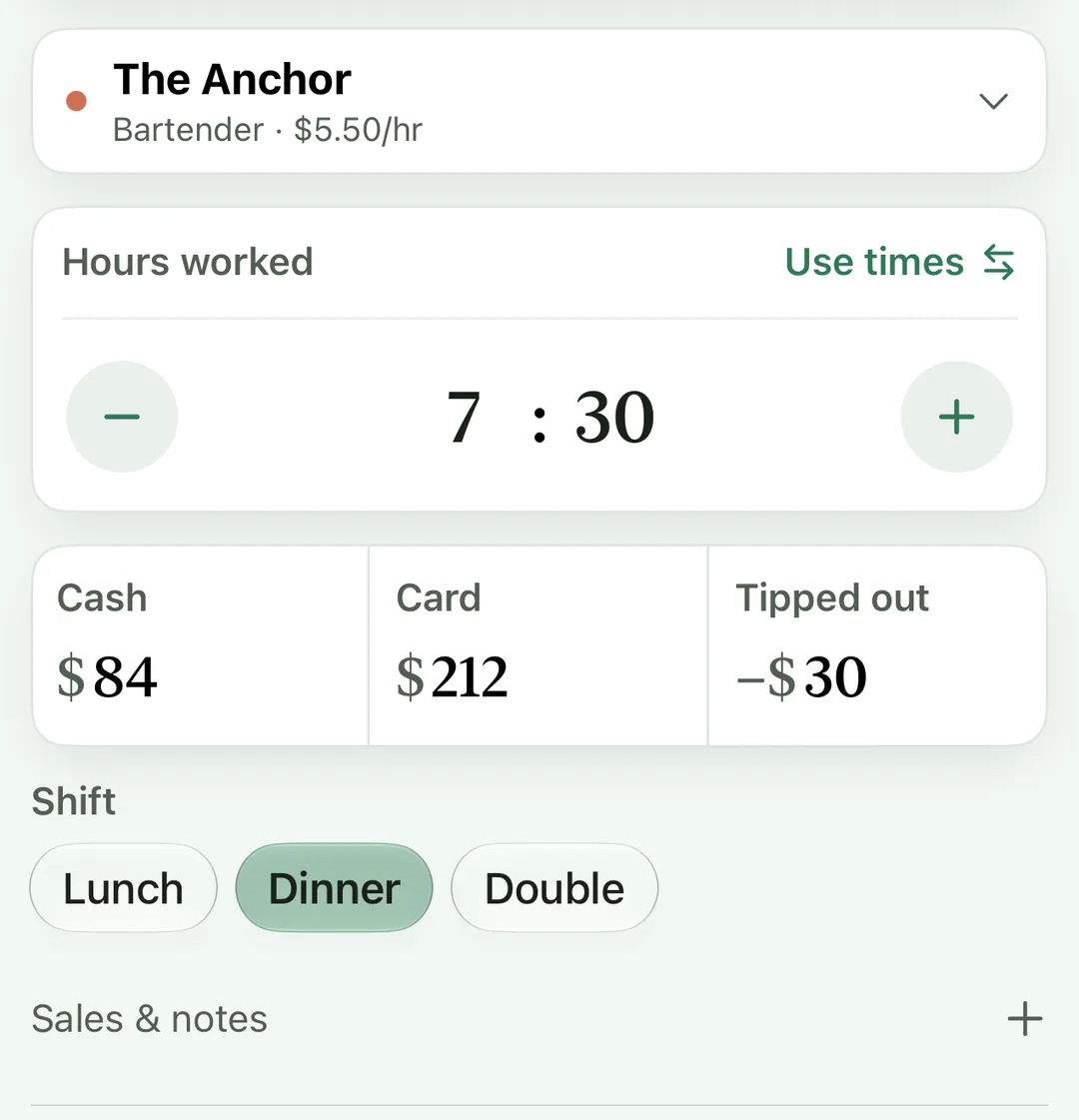
Tip’d, our free tip tracker for iPhone and Android, lets you log a shift with a note, so you can see what a ground stop really paid next to a normal Friday.
On this page
On Friday afternoon, November 13, 2026, every airport in the country stopped sending planes out. For almost four and a half hours nothing left the ground, and for the people who work inside airports, the bartenders, servers, baristas and everyone behind a counter past security, the terminal turned into a room full of people with nowhere to go. Here's what happened, what a shutdown like this does to a tipped shift, what it can do to your tips, and how to work the bar through one without overserving anybody.
What happened on November 13
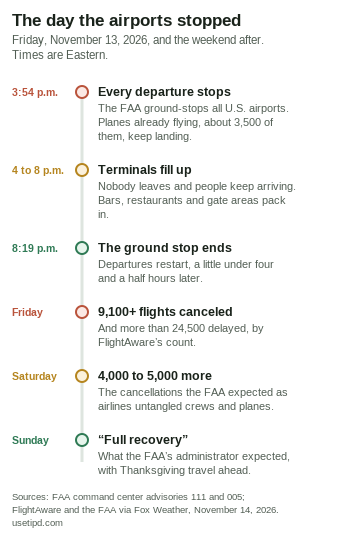
At 3:54 p.m. Eastern, the FAA's command center issued a national ground stop: “all airports are ground stopped,” and departing traffic was to stay put until further notice. Planes already in the air, about 3,500 of them, kept landing, so terminals kept filling while nothing went out. The stop was cancelled at 8:19 p.m. Eastern. By FlightAware's count, Friday ended with more than 9,100 flights canceled and more than 24,500 delayed, and the FAA's administrator expected another 4,000 to 5,000 cancellations on Saturday before a full recovery on Sunday.
As of November 15, officials blame a communications failure in the air traffic control network, and the exact cause is still under investigation. For anyone working in a terminal, though, the cause matters less than the shape of the day: a sudden crowd, no departure times, and hours of waiting. A KPRC 2 employee stuck at Atlanta's airport described crowded restaurants, bars and shops as travelers waited for word. At LaGuardia, some stranded passengers slept on the terminal floor Friday night.
What a ground stop does to a shift
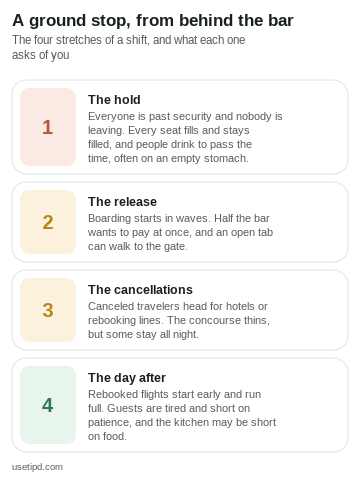
An airport bar is unlike any bar in town. Your guests are on a clock they don't control, nobody's a regular, and on a normal day the seats turn over every time a flight boards. A ground stop breaks that. During the hold, everyone who's already through security stays, and more arrive with every landing plane. Seats fill and stop turning. People who planned on one beer before boarding now have three or four hours and nothing to do, and many haven't eaten since breakfast.
Then it ends all at once. Boarding gets called in waves, and a dozen guests want to pay in the same two minutes, or don't, and walk to the gate with an open tab. Canceled travelers leave for hotels or line up to rebook, and the concourse can go quiet fast, except for the people who decide to wait it out overnight. The next morning brings the rebooked crowd: early, full, tired and short-tempered. Servers in sit-down restaurants and baristas at the coffee counters ride the same waves; the advice below about pacing, closing out and keeping calm works for them too.
How much more can you make?
Sometimes a lot more, and sometimes less. There's no published count of airport bar tips during ground stops, so treat anyone's number with care. What researchers have measured is the link between waiting and spending: a 2024 study of 89 U.S. airports found that when passengers spend more time in the terminal, airports earn more from shops and restaurants, about 5% more non-flight revenue for 10% more time, with food and drink among what rose. More time in the terminal means more money spent at the bar, up to a point.
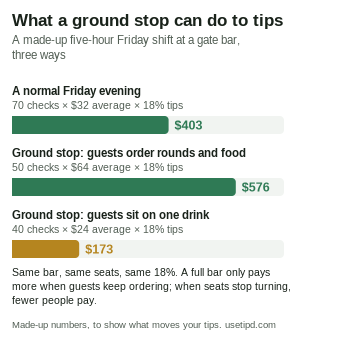
The point is in the math. Your tips are roughly your checks times their average size times the tip rate. A ground stop cuts the number of checks, because seats stop turning, and raises the size of each one, because people stay longer. If guests order round after round and get food, a shift can pay more than a normal Friday, about 40% more in the made-up example. If they nurse one drink for three hours while charging a phone, the same full bar pays less than a normal night.
A few other things cut the other way:
- Cancellations empty the concourse. Once flights cancel, a lot of your crowd leaves the airport, and the next evening can be thin.
- Don't expect a wave of meal vouchers. Airlines' meal promises on the Department of Transportation's dashboard are for delays and cancellations the airline causes, like maintenance or crew problems. A ground stop ordered by the FAA wasn't caused by the airlines. A voucher doesn't always come with a tip, either.
- The kitchen runs out. Airport bars restock through security and on a schedule. When the food goes, so do the bigger checks, and the drinking gets harder to pace.
- Mood swings both ways. Some stranded travelers turn the bar into a party and tip like it; others take the day out on whoever is in front of them.
If your shift runs long, remember that federal law requires time and a half for hours past 40 in a workweek. Our guide to your real hourly pay with tips shows how to see what a long night actually came to.
Don't overserve: why the airport makes it riskier
The biggest danger on a ground-stop shift isn't a slow night. It's the guest who's had too much, at a bar where nobody is driving home but everybody is about to get on a plane. Long waits, empty stomachs and no clear end make people drink faster than they realize, and an airport adds consequences a bar in town doesn't have.
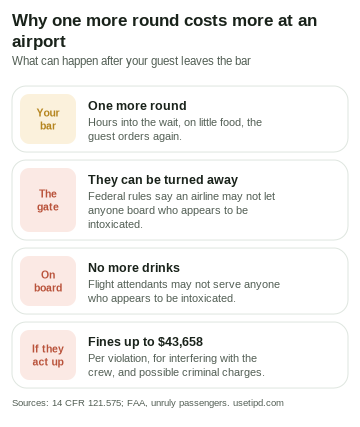
Federal rules say an airline may not let anyone board who appears to be intoxicated, and its flight attendants may not serve them. So the guest who waited four hours for a seat can lose it at the gate because of the last two drinks. If they do get on and cause trouble, the FAA can propose fines of up to $43,658 per violation against the passenger, one incident can count as several violations, and they can also face criminal charges. Those rules bind the airline and the passenger, not you. Your own risk comes from your state's liquor law and your employer. Most states can hold a bar responsible for harm caused by someone it served while they were visibly intoxicated, and in some states the sale itself is a crime for whoever makes it; in Texas, for example, selling alcohol to an intoxicated person with criminal negligence is an offense. Ask your manager what your state and your airport's concession company expect.
What one airport drink really is
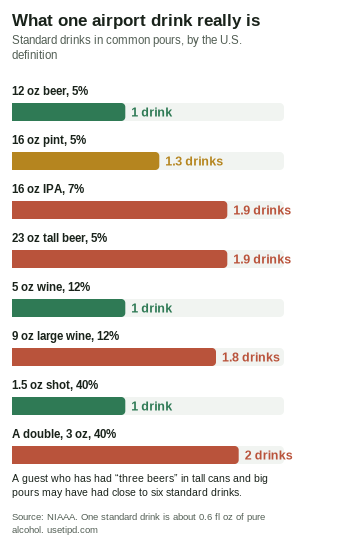
A standard drink in the U.S. is about 0.6 fluid ounces of pure alcohol: a 12-ounce beer at 5%, a 5-ounce glass of wine or a 1.5-ounce shot. Airport bars love tall pours, though, and a 23-ounce beer or a 9-ounce wine is nearly two. Three “drinks” can be closer to six. The government's alcohol institute also warns that blood alcohol can keep rising after someone stops drinking, and that hot coffee, cold showers and walking don't reverse it.
Drinking before a flight
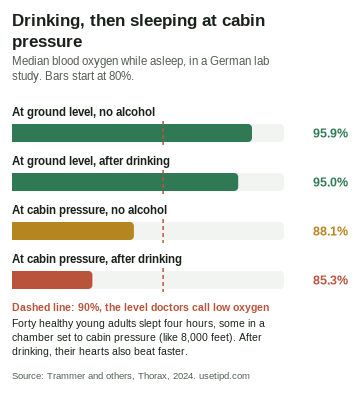
There's also the flight itself. In a 2024 study at Germany's aerospace center, healthy young adults slept four hours in a chamber set to an airliner's cabin pressure. After drinking, to a blood alcohol level of about 0.04%, their blood oxygen during sleep dropped to a median of 85% and their heart rates rose, compared with 88% at cabin pressure without alcohol. It was a small study of young, healthy people sleeping on a long flight's schedule, so it can't say how much a drink at the gate matters for everyone, but it's one more reason a long wait isn't the time for a long session.
Signs it's time to slow down
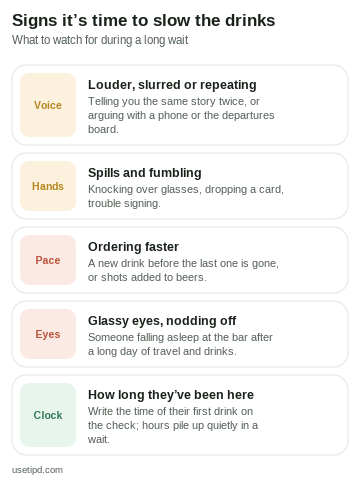
The usual signs still apply: louder talk, slurring, repeating the same story, spills and fumbling with a card. In a ground stop, two more matter. Watch the pace: guests start ordering the next round before the last is gone, or adding shots, because there's nothing else to do. And watch the clock. Nobody notices three hours going by at an airport bar, so write the time of a guest's first drink on their check and glance at it before every round.
How to cut someone off without a scene
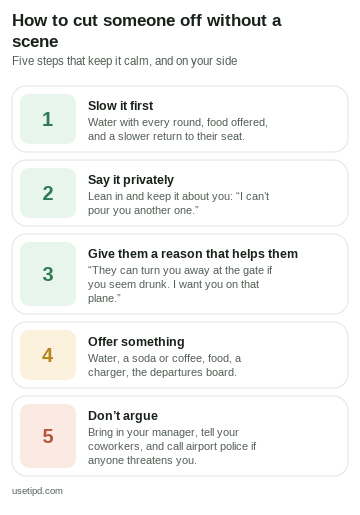
Cutting someone off is easier before they're drunk than after. Start slowing things down early: a water with every round, food offered as a matter of course, and a little more time before you get back to them. When it's time to stop, do it privately, not across the bar, and make it about you rather than them: “I can't pour you another one.”
An airport hands you something a bar in town doesn't: a reason that's on their side. “They can turn you away at the gate if you seem drunk, and I want you on that plane” isn't a judgment, it's help, and most people hear it that way. Offer something in place of the drink, like water, a soda, coffee, food or a place to charge a phone. If someone argues, don't argue back. Bring in your manager, let your coworkers know so nobody else serves them, and call airport police if anyone threatens you.
A checklist for the next ground stop
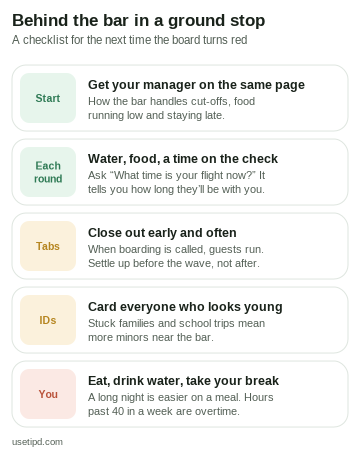
- Get on the same page early. As soon as the board turns red, ask your manager how the bar will handle cut-offs, what happens when food runs low, and who's staying late.
- Ask about the flight. “What time is your flight now?” is friendly, and it tells you how long a guest will be with you, and how many hours of drinking you're looking at.
- Close tabs early and often. When boarding gets called, people run. Ask guests to settle up when you see a gate change, or between rounds, rather than at the wave.
- Card anyone who looks young. Stranded families and school groups put more minors near the bar than usual.
- Take care of yourself. Eat something, drink water, and take your break; it may be a long night.
- Write it down. Log the shift with a note, “ground stop,” so the next time it happens you know what it paid.
Thanksgiving is next
The Transportation Secretary said he expected travel back to normal before Thanksgiving, the busiest stretch of the year for airports. Nationwide stops are rare. Before this one, the last came in January 2023 and lasted about 90 minutes, according to Fox Weather. Ground stops at single airports for storms, fog or staffing are not rare at all, though; Atlanta had one for thunderstorms on November 4. Every one of them fills a terminal the same way, just smaller. If you work in an airport, the playbook above is worth keeping, and our guide to working the holidays covers the rest of the season.
Questions people ask
Can a bartender get in trouble if an airline turns away a drunk passenger?
The federal boarding rule binds the airline, and the FAA's fines are for passengers. Your own risk comes from your state's liquor law and your employer's policy: most states can hold a bar responsible for serving someone who is visibly intoxicated, and in some the sale itself is a crime. Ask your manager what applies where you work.
Do airlines give meal vouchers during a ground stop?
Usually not for this kind. Airlines' meal and hotel promises on the Department of Transportation's dashboard are for delays and cancellations the airline causes, like maintenance or crew problems, and a ground stop ordered by the FAA wasn't caused by the airlines. Some airlines hand out vouchers anyway, so check with the guest and your manager about how a voucher works at your register.
Do bartenders make more money when flights are delayed?
Often, but not always. Longer waits mean more spending in airports overall, so a delay can mean bigger checks. But seats stop turning, cancellations empty the concourse, and guests who nurse one drink pay less than a normal crowd. Your own records are the best answer.
Are airport tips taxed differently?
No. Tips you earn at an airport bar are reported and taxed like any others, and bartenders count for the federal tip deduction. Our guides to reporting cash tips and the No Tax on Tips deduction explain both.
Sources
- FAA Air Traffic Control System Command Center: advisory 111, national ground stop (November 13, 2026)
- FAA Air Traffic Control System Command Center: advisory 005, nationwide ground stop cancelled (November 14, 2026)
- Fox Weather: FAA expects “full recovery” by Sunday (November 14, 2026)
- KPRC 2: Travelers stranded at Atlanta airport during nationwide ground stop (November 13, 2026)
- Atlanta News First: Ground stop issued at Atlanta airport because of thunderstorms (November 4, 2026)
- 14 CFR 121.575: Alcoholic beverages
- FAA: Unruly passengers
- U.S. Department of Transportation: Airline cancellation and delay dashboard
- Wu, Morlotti and Mantin, “Shopping or dining? On passenger dwell time and non-aeronautical revenues,” Journal of Air Transport Management, 2024
- Trammer and others, “Effects of moderate alcohol consumption and hypobaric hypoxia,” Thorax, 2024
- National Institute on Alcohol Abuse and Alcoholism: What is a standard drink?
- National Institute on Alcohol Abuse and Alcoholism: Understanding the dangers of alcohol overdose
- Justia: Dram shop laws, 50-state survey
- Texas Alcoholic Beverage Code, section 101.63: Sale or delivery to certain persons
- U.S. Department of Labor: Overtime pay